

We all know that altitude and heat impact performance. It’s not rocket science. Just come train in Houston, Texas or go up to Park City, Utah and you’ll feel the effects pretty quickly.
But with the World Cup we got an interesting case study to help quantify how each impacted performance just by following England’s journey. I covered altitude and heat before each of their matches, but it’s worth a deep dive retrospective to see what actually occurred.
England played their first 4 games either indoors or in temperate climates, before then playing Mexico at Mexico City (7,200 feet altitude) and Norway outdoors in Miami (120 minutes in hot and humid conditions). Before playing Argentina a few days later at an indoor stadium.
This provides a nice baseline of normality for their play before we can take a look at what altitude, humidity, and fatigue do to their players. I used FIFA’s in depth statistics to look at total distance run, high speed running distance, sprint distance, and number of sprints completed.
Notes: To standardize because Norway went 120min versus other games 90, I calculated meters per minute to help give us a better comparison. Zone 4= anything above 20km/hr. Zone 5 = anything above 25km/hr.
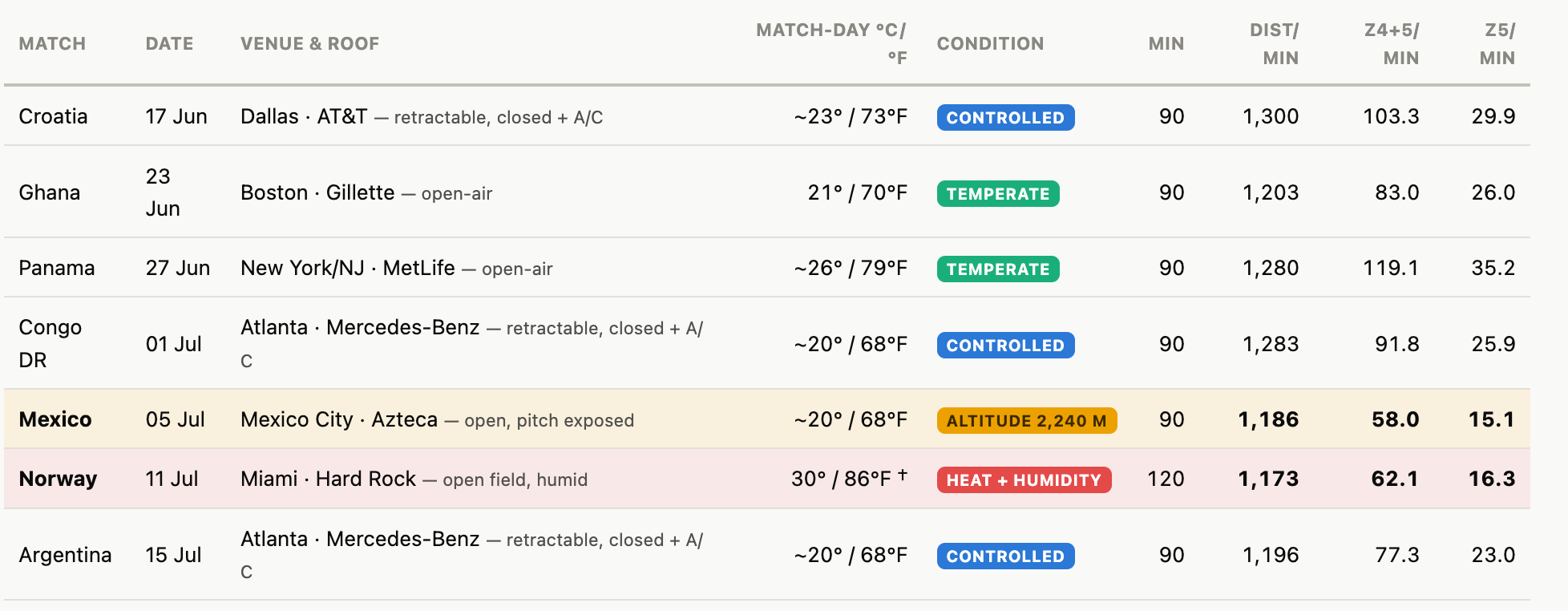
The Impact of Altitude:
What’s clear to see is that during the group stage, there were some slightly different metrics based on style and tactics of the game, but it’s all in the same bandwidth. Then, we get to Mexico City and altitude…
Total distance covered dropped slightly, but what really fell off a cliff is the higher intensity runs. Zone 4 and 5 declined by between 39 and 48%. A huge drop off compared to what they were doing before. Yes, tactics shift and playing in a low block tends to decrease this, which they were doing for part of Mexico, but you can tell the altitude drop off because it’s much lower than when England defended for 30+min against Argentina.
So the altitude hit was real and significant…
One question is how big was it compared to Mexico, who should have been better adapted after training and competing up there. Well, I ran the numbers here too:
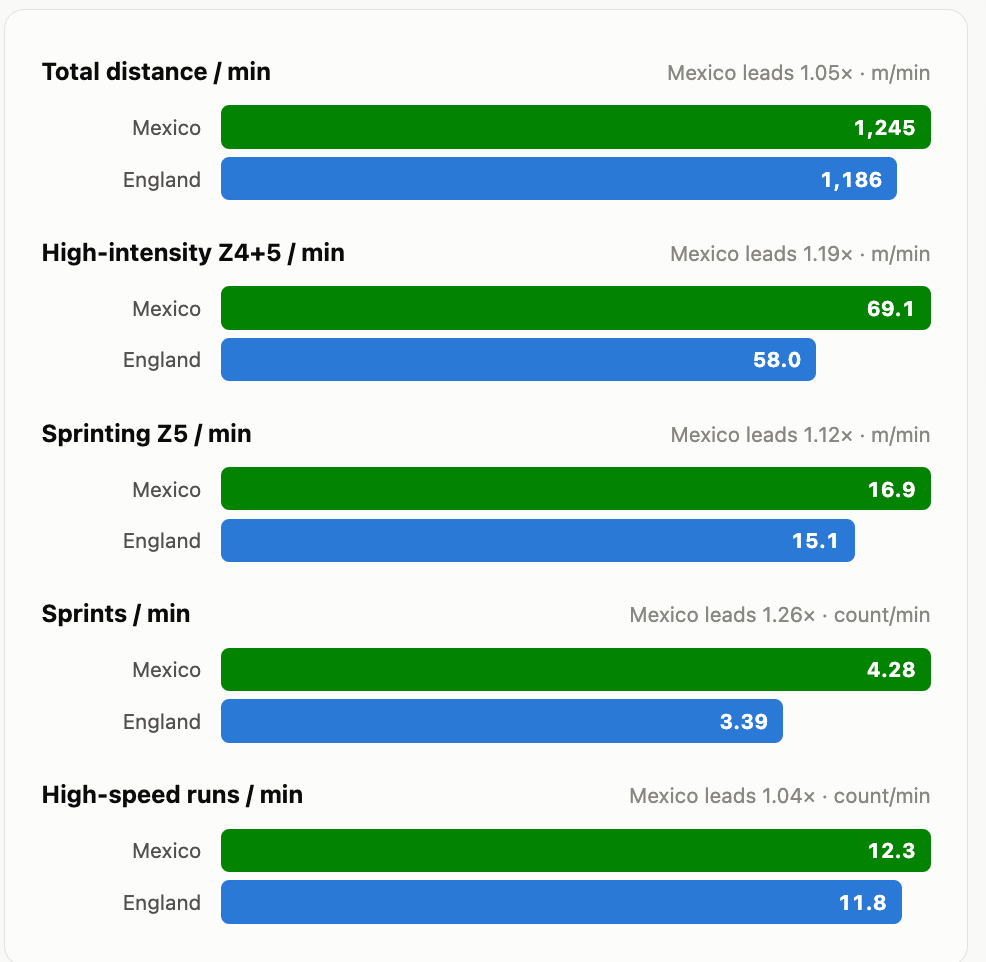
You can see that Mexico has a slight to significant advantage in every category. If we looked at every other game that Mexico played at their home stadium, the numbers are even higher for them. Showing that they consistently had much higher high speed running metrics at altitude.
The bottom line on altitude: It did exactly what I outlined before hand: it significantly impacted high speed running, both in distance covered and number of sprints. And tended to have a greater effect on England than Mexico. Which makes sense because one side was acclimatized and the other wasn’t.
Could England have done anything about this? Small tweaks might have helped, as I outlined before the match. But the truth is with such short times between games and this not being the primary target, it’s hard to employ strategies like longer term acclimatizing that would have helped.
Mexico’s home field advantage is real and significant. It forces teams to change how they play.
What About the Heat?
After surviving the altitude, England headed to Miami to play Norway in a 120 minute match that took place with upper 80 degree Fahrenheit weather with high humidity. In other words, miserable conditions.
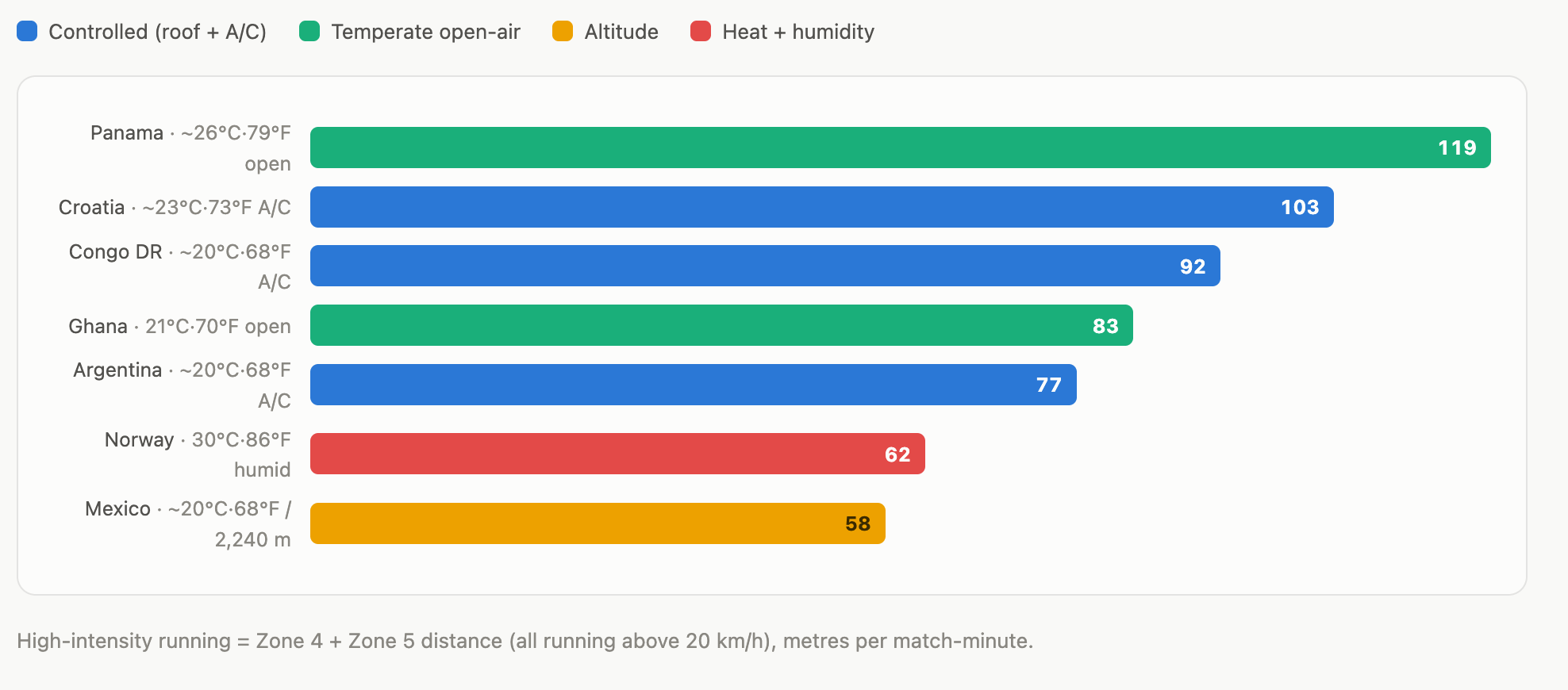
What impact did the heat have? It mirrored altitude really well. We can see it in the decline of high-intensity running for England (meters/min).
And we can see across every variable we tracked. On average, heat comes in pretty dang close to the same decline (when compared to the baseline 4 games before we hit round of 16 and round of 8).
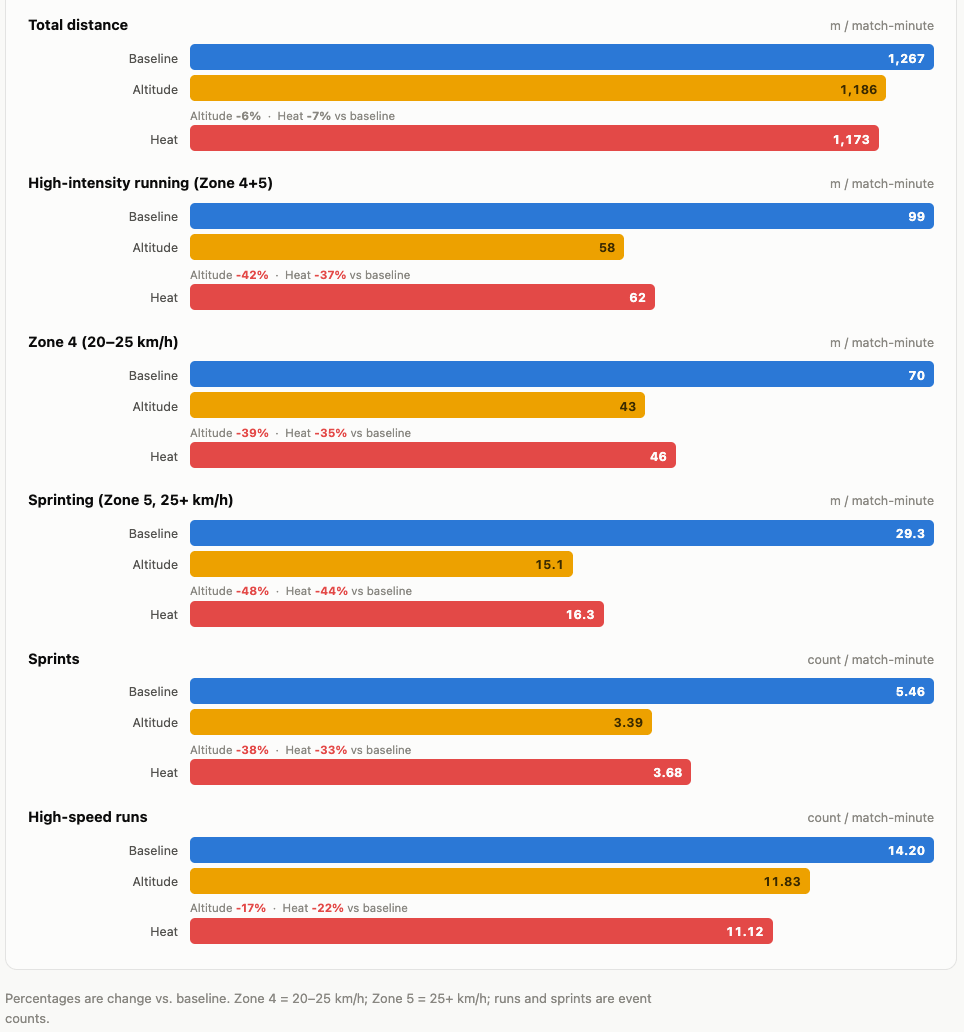
Heat sucks… Now, there is a caveat here. The Norway game went 120 minutes. So even though it’s normalized for per minute, we can’t discount that the last 30+min were in a more fatigued state so high intensity or sprint running could have been dragged down a bit. That’s a fair critique. I don’t have data split by half, just the totals. But regardless of that, the drop was significant and remarkably similar to altitude.
But who handled it better? When we looked at altitude, the adapted Mexico team had a clear advantage. With heat, we’ve got two European teams who spent time training in the heat and preparing for it. Who fared better?
First, let’s look at Norway’s baseline and drop data:
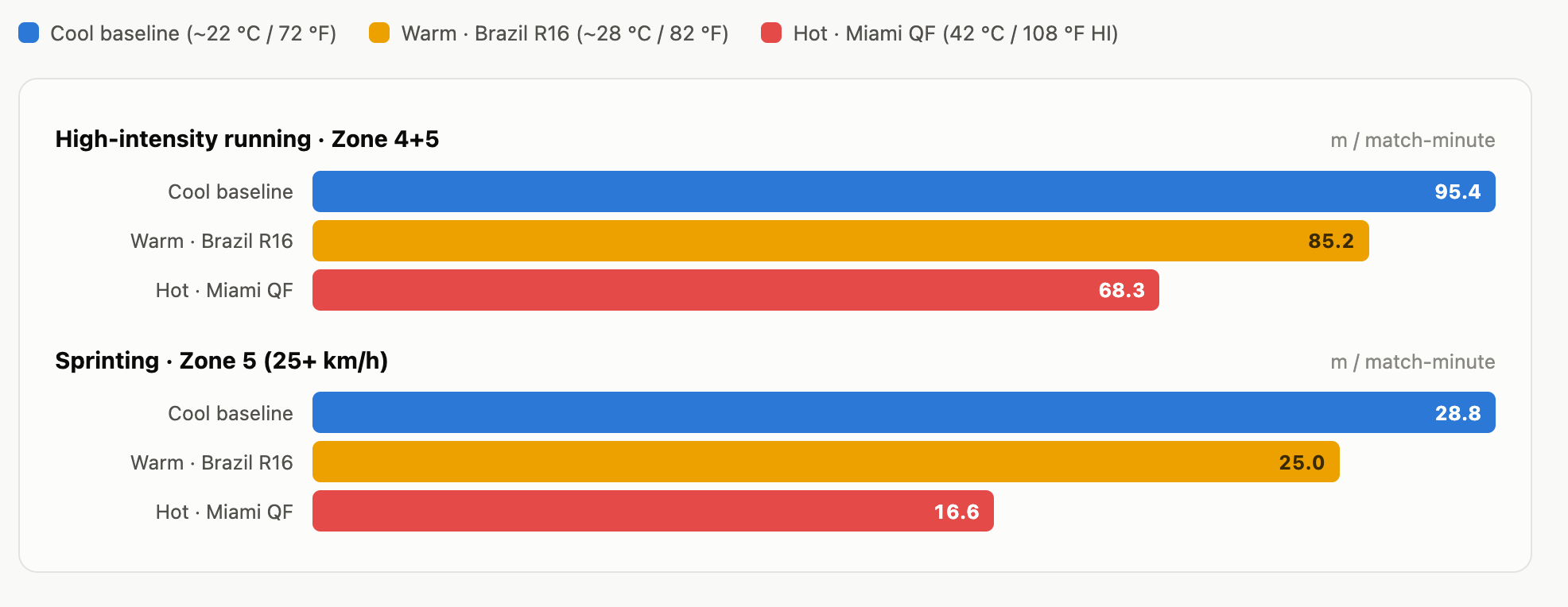
As you can see, a pretty steep drop in high intensity and sprint running. In particular, it’s interesting to see the impact of a warm but not quite as hot and humid game against Brazil.
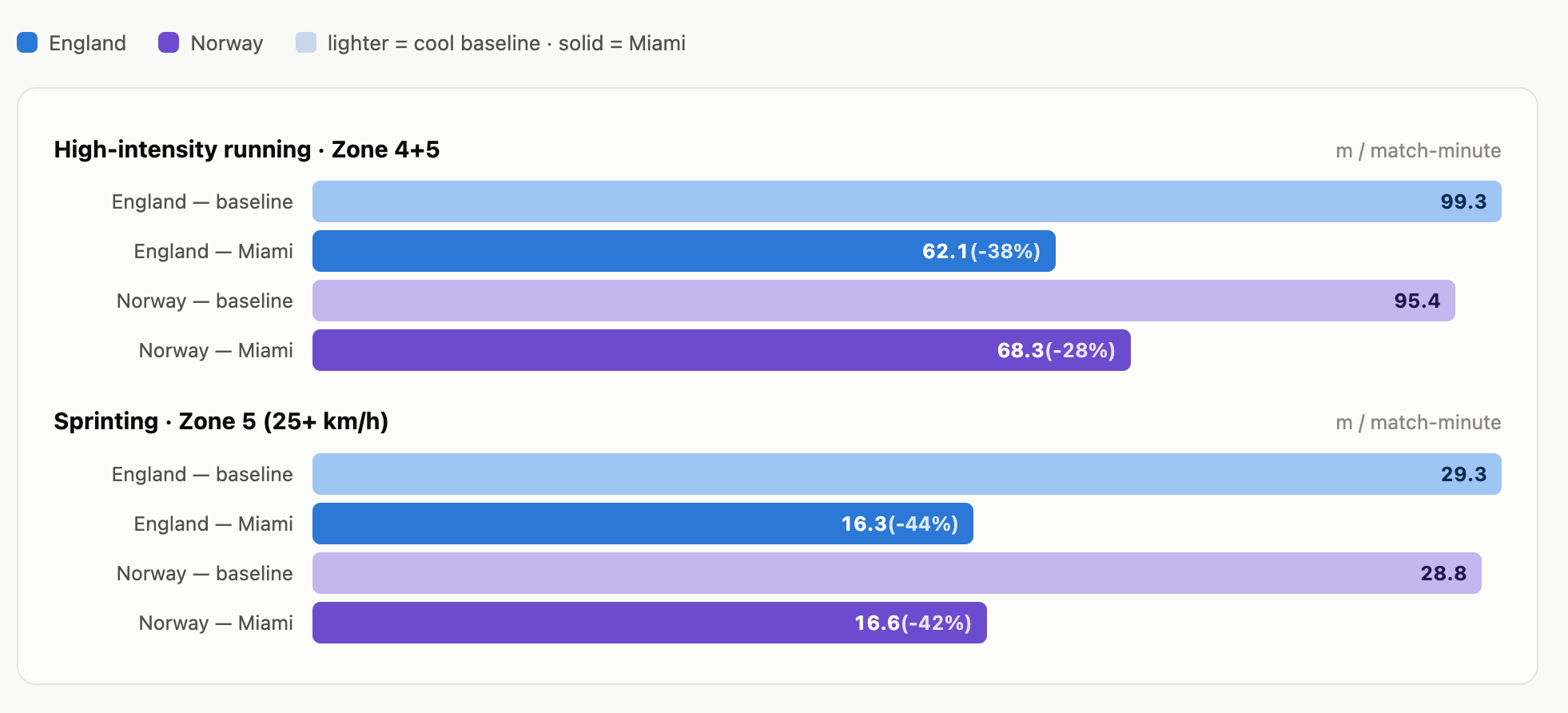
When we compare them versus England, we get a relatively similar drop off. Norway seemed to hold up a little bit better with high intensity running and their sprinting was about the same.
So who was better prepared? It’s impossible to say from this data. They both saw a big dropoff, though Norway may have handled it ever so slightly better. Though, officially, I’d call it a toss-up.
What about Fatigue?
And the final question…did playing in hot and humid conditions for 120min, then having one less day to recovery cause undue fatigue against Argentina?
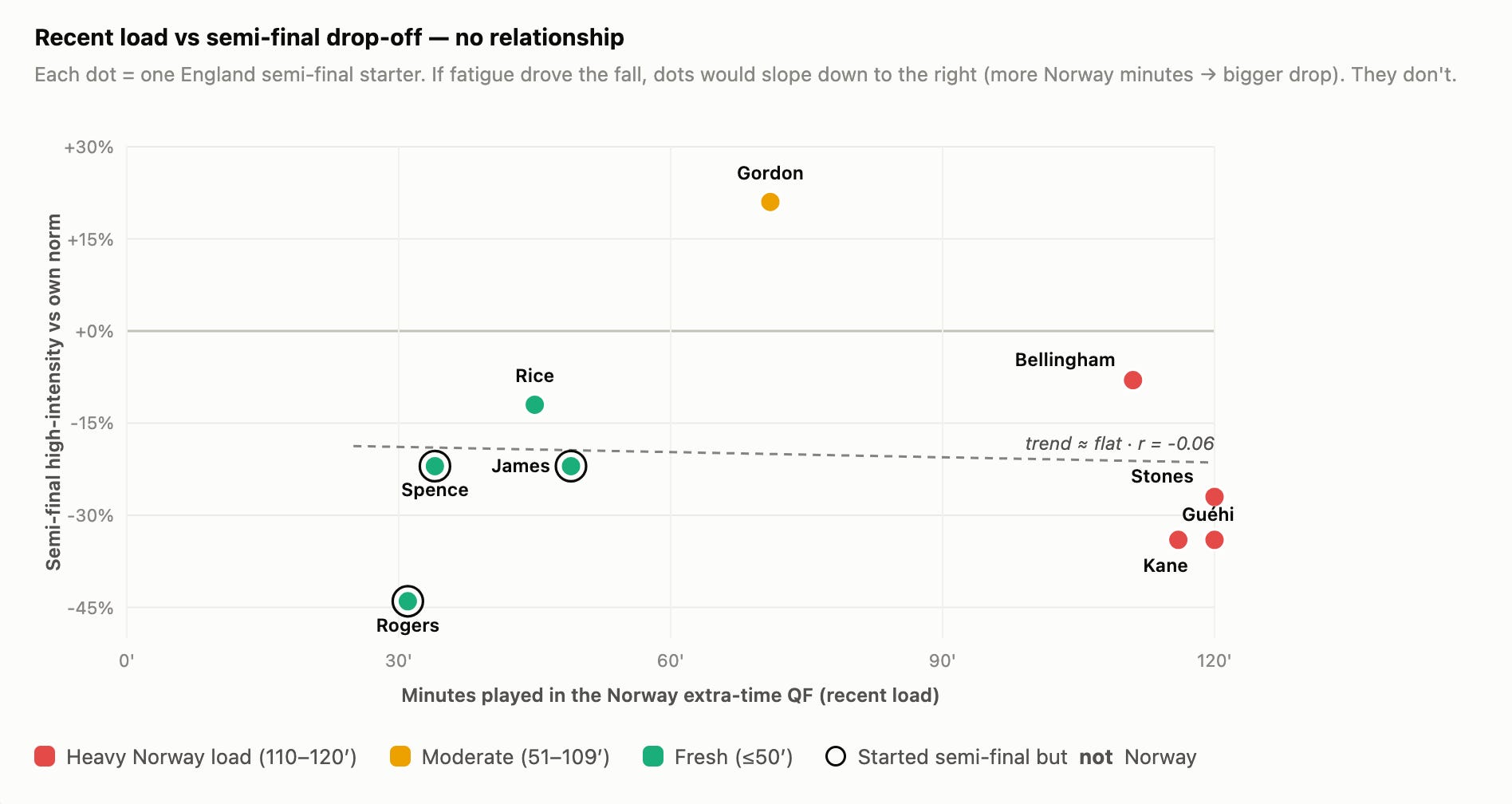
This is the hardest question to answer because there’s no available data source to truly answer it. So we have to get a little creative. For England, if we compare players who only played a part of the Norway match to those who played nearly the whole time, and then looked at their high speed decline against Argentina versus their baseline data. It’s not perfect. But in theory, if fatigue was the culprit, those who played significantly less would have held up better.
That wasn’t the case. Although it’s a small sample size, you can see that those players who played less than 50 minutes against Norway versus those who played nearly the entire game had about the same percent drop in high intensity running against Argentine. Gordon was the only exception.
So what?
Heat, humidity, and altitude all have significant impacts on soccer play. In particular high intensity running significantly declined in each. This is exactly what we’d expect to happen, but nevertheless, it’s cool to see the data lines up with theory and research. If you aren’t preparing for altitude or heat when playing 90+ minutes of soccer, you are at a significant disadvantage.
-Steve