

In one corner, there was Aryna Sabalenka. Wearing her emotions on her sleeve, smacking a ball in anger mid-match, then smashing her racket and telling a cameraman to F*** off after losing.
In the other, Elena Rybakina. Showing nothing, never betraying a thing about what was happening inside. Jessica Pegula called her “cool as a cucumber…She doesn’t really give you anything.” After losing to her in the semifinals, Coco Gauff said, “just no reaction ever. I’m sure it may appear that way, but we’re all feeling nerves. How much of that she lets get to her, we don’t know. And I think that’s the strength of her. You can never see what she’s feeling.”
Gauff had it right. Rybakina felt all the pressure, stress, and frustration that we all do, but she’s a master at concealing it. As she relayed, “I’m trying to hide it, because you just don’t want to let the opponent also see your frustration when something is going wrong…Even maybe my face didn’t show, but inside it was a lot of emotions.”
The simple conclusion is that composure wins. We all should do our best impression of Rybakina. But while Rybakina won this battle, overall, these two champions have battled 18 times with a 10-8 edge to Sabalenka. They just exchanged world ranking positions with Rybakina elevating to no. 1 and Sabalenka falling to no. 2. By any measure, both players are great and get the job done.
When it comes to our emotions, we make all sorts of mistakes. We get told to do our best imitation of one style or the other. Be stoic. Be passionate. Or we expect anger to always be bad. Or being stoic to always be good. Neither are true. What research and practice tells us is that there is no single way to the top, and every approach comes with its drawbacks.
Nearly every emotion can help or hinder performance, and it varies by the person and by the moment. According to the Individual Zones of Optimal Functioning model, we all have and optimal zone— a particular combination of emotions and the intensity they bring. Meaning, some do better with anger and heat. Others with calm. And even states we think of as positive, such as relaxed and composed, get rated as hurting performance by some athletes.
We all need a different mixture. And that mixture shifts depending on whether we’re trying to hit the ball as hard as we can or control exactly where it lands. Here’s an example of one graph that the IZOF profile produces (Note: It’s an example, there will be vast differences for the intensity of each emotion)
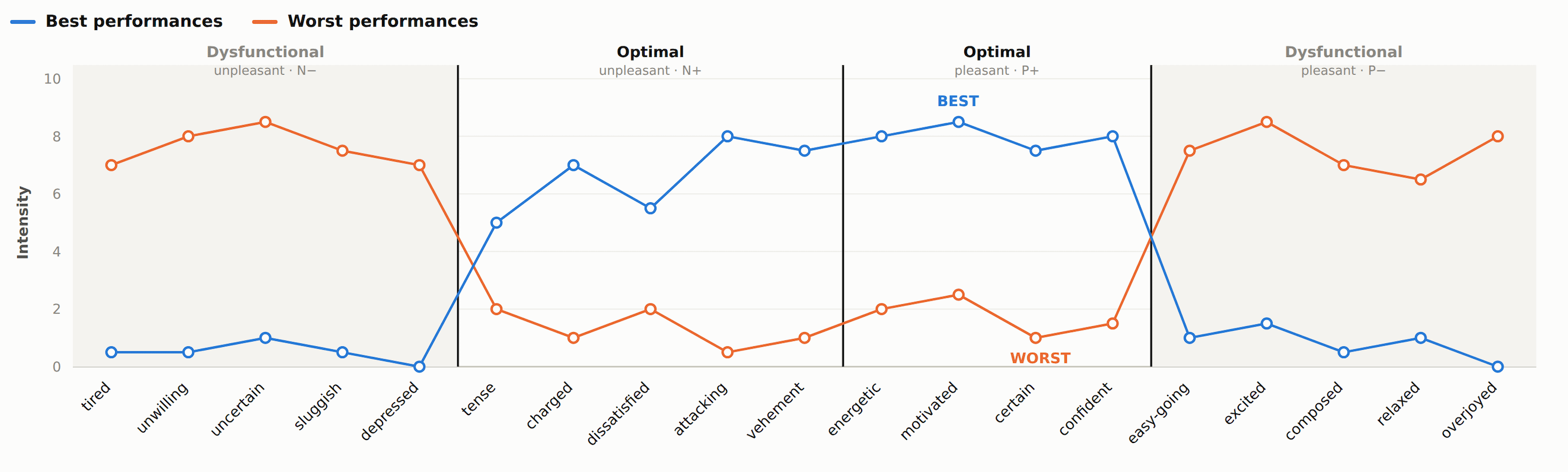
.Calm and intensity are tools. Either can help you perform. A mature competitor knows which one tends to work best for them, what the moment requires, and how to change states when the current one isn’t working. It’s about aiming and directing the emotion, and not letting the fire consume you, and not letting the need to say under control drive you nuts.
And we’ve known this for a really long time.
The Fire Within
Over 1400 years ago, the man who popularized the seven deadly sins, Gregory the Great, split anger into two categories: ira per vitium (through vice) and ira per zelum (through zeal). As Gregory wrote, “The first is engendered of evil, the second of good…Anger that comes of evil blinds the eye of the mind, but anger that comes of zeal disturbs it.”
Both angers come with a cost, it’s just the one that’s pointed in the a direction that allows you to stay just in control enough to utilize it. Gregory warned us, “We must beware lest, when we use anger as an instrument of virtue, it overrule the mind, and go before it as its mistress, instead of following in reason’s train, ever ready, as its handmaid, to obey.”
The early medieval worked out that what matters is who's holding the reins. Anger as a handmaid means reason chooses the goal but anger supplies the energy. While anger as a mistress is when the emotion seizes control, and the retaliation or release becomes the goal.
Modern research expands on the old work showing that it’s what’s underneath, where it’s directed, and whether you maintain control that matters.
Outside of sport, when researchers give people a choice to choose anger, they found that it improved performance. They were in control and chose to do it, instead of being ambushed by the anger and spiraling towards rage. While other work finds that anger directed at a goal can increase muscular force, particularly in extroverts.
And in sport, when a coach’s anger was moderate rather than overwhelming, and directed at a fixable, specific goal, it tended to help performance. When the anger was at the referee, not so much (i.e., you can’t do anything about that).
Combining ancient wisdom with modern research, we can split anger into a few different categories:
Productive anger: aimed at the next action.
Cathartic anger: expressed to deal with the feeling.
Reactive rage: the anger itself replaces the original goal.
We may as well be talking about Sabalenka. In the first set, after a double fault, she smacked the ball away and picked up a code violation. She lost her cool and then lost the set. In the second set, she seemed to channel that same heat into the play itself, winning the set. But then as she lost, the temper tantrum afterward was the cathartic variety.
Can you fuel that anger into productive aggression, where it’s aimed at the process or goal you want? Or does it turn into reactive rage, where all of the sudden you’re making a stupid mistake or getting a technical foul because the anger was controlling you, and you forgot the long term goal
And while catharsis might seem logical. Most of the research tells us that it doesn’t release the anger, it just fuels it. A study by Brad Bushman found that The people who vented ended up angrier and more aggressive than the people who did nothing. As the lead author put it, “venting to reduce anger is like using gasoline to put out a fire — it only feeds the flame.”
If it seems messy, that's because it is. Researcher studying elite figure skaters and gymnasts found that the emotions they call "optimal-pleasant" — energetic, confident, motivated — had a linear impact. More was better. But the “optimal-unpleasant” emotions followed a bell curve. That's a fancy way of saying emotions that feel bad in the moment and help anyway: tense, dissatisfied, attacking. They help, up to a point.
Intensity is a double edge sword. The fire can be your greatest asset, fueling your pursuit. But it’s really easy to get burned by it, and make you spiral.
Composure
So anger can burn us, what about composure. Surely, that’s only a positive right?
Well, first off, it takes work to be composed. Remember, Rybakina admitted that she feels all of those emotions internally, she just hides them. That takes energy, and sometimes backfires.
One study found that suppressing facial expression worked well as a poker face, hiding what an observer could see in terms of their emotional state. But it didn’t reduce the experience the participant themselves was feeling. In fact, in some measures they had an increase in sympathetic activation. Meaning a blank face isn’t a calm nervous system.
That active regulation takes mental energy. Some research shows that suppressing emotions impairs memory. While other work finds that trying to hide something can make it come back stronger, because you are directing all your attention at the thing, which tells your brain that emotion is important.
This is why sometimes you see people break and go from collected to completely gone because they can no longer hold it together. And unlike the fiery player who can sometimes get it back under control because they are used to outbursts, once the dam breaks on someone who’s entire game is composure, it’s much harder to put everything back into that broken bottle.
Which brings us to the real point. When Rybakina says she’s “hiding it”, that doesn’t mean she’s spending all her energy suppressing it. Yes, she may be doing so to control her facial and bodily expressions. But in her head, she’s likely using other strategies like repappraisal to deal with the emotion itself.
Suppressing the face isn’t the same as suppressing the feeling.
The way I like to think about this is it gets more expensive to handle an emotion once it’s surfaced. Meaning, if you can get upstream of it by altering the situation and how you’re framing it or what your giving attention to, it’s a lot easier. Than doing so downstream when you feel the entire brunt of the emotion and try to suppress, push away, ignore, or distract yourself from it.
At the same time, if your default is to be calm, cool, and collected, you miss the jolt. You don't get the commitment that comes with productive anger aimed at something. Rybakina has talked about exactly this. "For me, it's important sometimes to show the emotions, to show the opponent that I'm there for different moments of the match… even when I sometimes don't feel good, this is the moment when maybe you should show the opponent — fake it a little bit." Her coach Goran Ivanisevic put it more bluntly: "Definitely not going to see her breaking racquets but hopefully she does show more emotion."
When things are going poorly, it’s easy for our brain and body to default to flatness. It feels like composure, but really your brain’s effort calculator is falling into the trap of “what’s the point, there’s no hope,” mode. Something that even the best of the best experience.
As strange as it seems, the outward expression of anger can act as both a signal to your opponent and to yourself that you still care and this still matters. When some people lose it a bit, they’re intentionally trying to disrupt the pattern to get their brain back engaged and caring enough to go for it.
For some people that's incomprehensible. But every so often you get the athlete who genuinely wants to be cussed out mid-race to snap back in. Or the one who slaps themselves in the face or punches the ground to get out of the rut.
Of Fire and Ice
Everything works…and doesn’t. That’s the real truth about elite performance. There is no magic secret or best state or preferred emotions. They all vary.
Step one is figuring out what kind of competitior you are. That doesn’t mean that state is locked in stone, you can shift and nudge things with practice. But identifying where you tend to perform well, what tends to help you, and what doesn’t is where it all starts.
Step two is identifying where you break. The thing that makes you good is often what prevents you from being great.Your fire got you in the door. Learning to hold it just short of the edge is what gets you over the hump. That’s true of every state or emotion. Each one comes with a downside, and your goal is to minimize it without losing what makes you you.
This is a gross simplification, but we can almost see our two tennis stars in this way:
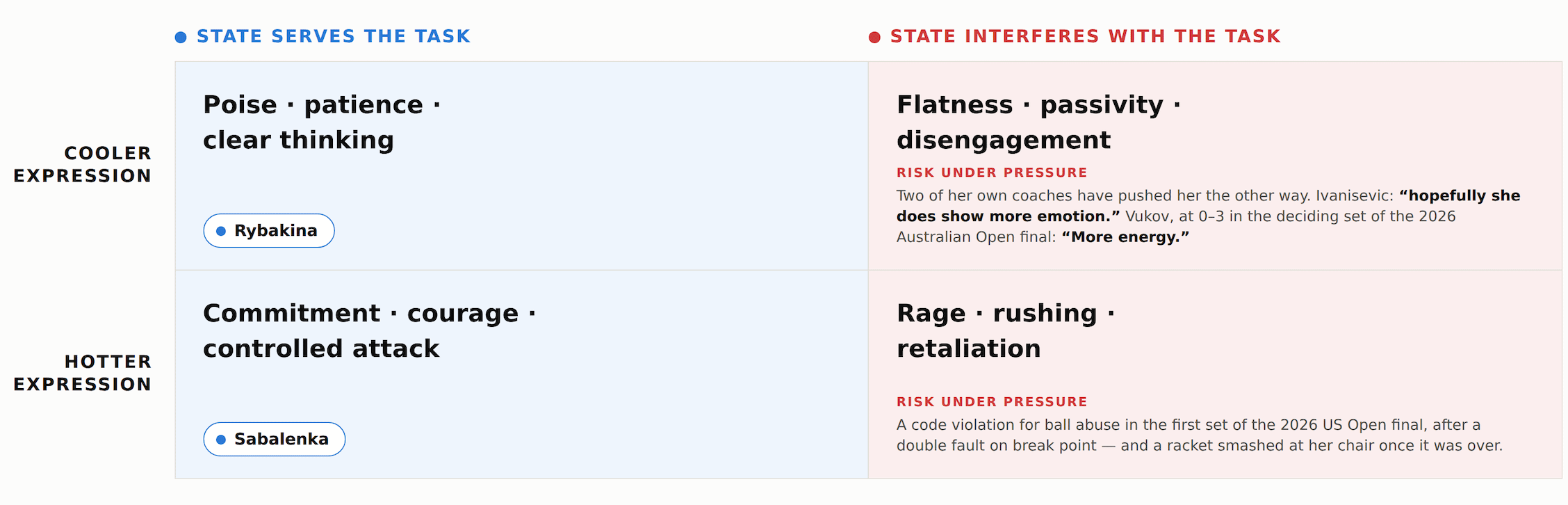
At their best, both are in control and regulating well. They’re just using different strategies to get there. Rybakina’s poker face is part of how she manages her emotions. While Sabalenka has admitted that expressing her emotions is a way to both cope and perform. She needs to fight, to be a warrior, and trying the opposite doesn’t work. “Everyone says, 'You have to be in control, you have to be flat with your emotions, don't show anything.' And I found it was destroying me from the inside."So she asked her team to be the release valve. "I asked my team to be OK with me yelling at them; like, just throwing this aggression to someone that can handle it, just so I can continue fighting on the court."
When they lose control, they come apart in different directions.
So this isn’t a situation of one being better than the other. Sure, from a spectator and sportsmanship standpoint, Sabalenka’s racket throwing and f-bombs aren’t pleasant or setting good examples. She’s acknowledged as much, and even apologized to other players before. That’s the battle of someone with fire, to keep it just under control.
But each competitor allows us to see there are many ways to to the top. And if we tried to reverse each of these competitors, we’d almost certainly make them worse.
But between them you can see that there are a lot of ways to the top. And if you swapped these two competitors' temperaments, you'd almost certainly make both of them worse.
The best learn to carry a little of both. They know their default, and they train to bring the other thing when the moment asks. It’s why even Michael Jordan needed the zen-master Phil Jackson to counterbalance his fiery, take everything personal, make up insults persona.
If we don’t build the counterweight, we either get burned or extinguish the flame.
When we step into the arena, we’re met with contradictions that are hard to understand. We want to be maniacally obsessive but also able to let it all go and trust ourselves when the moment demands. We need to possess a will to win, while still being able to detach from the outcome. We need to be a bit selfish and a bit selfless. You don’t pick one side. You learn to hold both, in a way that still feels like you.
-Steve
P.S. I’m working on some research on how YOU or performers you lead handle the arena. Fill out this survey if you want to help. It takes 5 minutes.
Thanks so much for reading my work. If you enjoyed it consider sharing it with others. The only way quality work spreads is if you help out.
Second, consider subscribing. You’ll get a free weekly newsletter on a topic about mental or physical performance and what genuine excellence is all about.
If you want to keep the conversation going, I’m active on the following social media platforms:
Instagram: Steve Magness
Twitter/X: @Stevemagness
YouTube: Steve Magness
Facebook: Steve Magness
Typo. “We need “