

It’s time to get controversial.
Do women close the gap on men in longer distance races? It’s a common belief. Just look around. Articles abound from the BBC, The Guardian, and well, tons of outlets. It’s been repeated in everywhere from academic books to social media. Often, accompanied by reasons for why this is the case: women have more slow twitch muscle fibers, more fat stores, more efficient fat utlization, and other true physiological differences.
But…they’re wrong.
The gap does NOT shrink as distances get further in running. In fact, in most cases, the gap is larger. We can see it when comparing the world records for the common ultra distances. For reference, the track events average ~10% differential.
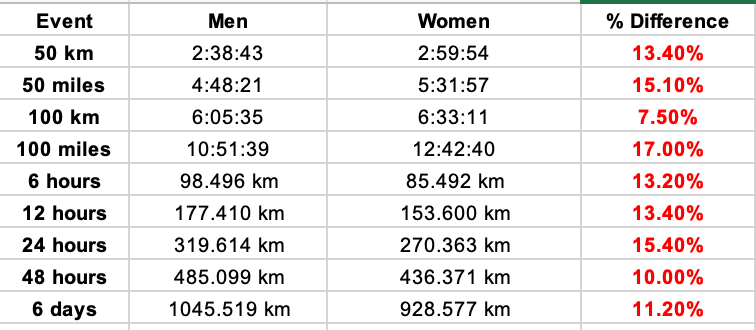
Nearly every single distance, with the exception of the less commonly run 100km, is much larger than their track companions. It seems pretty cut and dry. At minimum, the gap remains. Women don’t close it up to 6 days of racing.
So why do so many get this wrong? Let’s take a look at some bad stats and some good storytelling.
A Good Story Gone Bad
In 1992, a short paper was published in the prestigious journal Nature entitled, “Will women soon outrun men?” The provocative study hit a nerve, and gained a lot of press coverage. In it, they mapped out the progression of the world records in various events for men and women. Then, they continued that slope far off into the future, to see if the women’s line would intercept with the men’s.
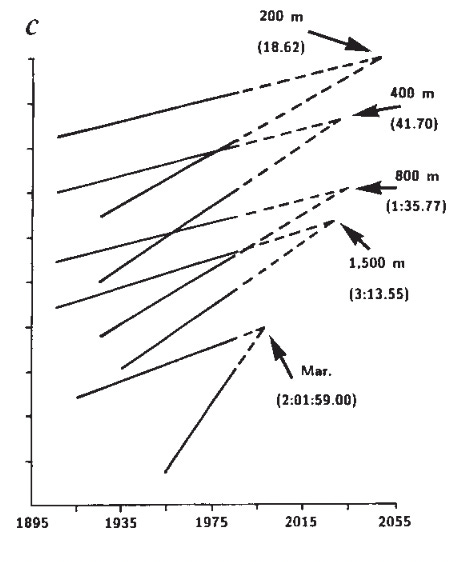
Lo and behold it did. And quite quickly for the marathon. They projected that by the 2000s, women and men would both be running 2:01:59!
Well…that didn’t exactly happen. And there was a clear as day reason that women were progressing more rapidly in most events, and in particular the marathon…they hadn’t been competing in them as long!
It wasn’t until 1928 when women’s events were even included in the Olympics. It wasn’t until 1960 that women could run anything longer than the sprints. And the marathon wasn’t an Olympic event until 1984!! So when you aren’t allowed to compete for a long time, and then suddenly you are, performances improve rapidly.
Since 1992, what’s occurred is that progress has leveled off. And the gap has remained about the same in most events.
But this narrative stuck. The idea that women are better at longer distances had some physiology to back it up.
It is true that women have more slow twitch fibers, on average. It’s also true they have more fat stores and tend to be a bit more fuel efficient than men with those stores. There’s even some data that shows that estrogen may have a protective effect against muscle damage in longer races. All of these gave a bioplausible why. We could theorize that, sure women might not have as big an engine, or produce as much power, but these other advantages pay off over the longer races.
But once again, these are small components. For instance, better fat oxidation is great, but that benefit is negated to a large degree when we consider that ultras aren’t completed in a fasted state, you get to fuel along the way! And the other advantages are great, but they’re negated by the fact that men tend to still have a bigger engine and a larger speed gap, so that at a given intensity it’s lower relative than their max. Men's 10-15% advantage in VO2max and hemoglobin concentration acts as a ceiling that these smaller efficiencies can't breach. It's like having slightly better fuel economy in a car with a much smaller engine.
While women demonstrate real physiological advantages, these don’t overcome the fundamental oxygen-delivery constraints imposed by sex differences in hemoglobin, cardiac output, and testosterone-mediated adaptations. (* Interestingly, women’s ultra swimming appears to be an exception to this thanks partially to the larger body fat stores providing a significant advantage in thermal insulation and buoyancy.)
But what really made this explode is a misunderstanding of statistics…
The Study Average…
In the late 2010s and early 2020s, a few studies (here and here for examples) came out that resulted in eye popping headlines such as “Female ultra runners are faster than male ultra runners!”
But once again, there was a major problem in their interpretation.
All these studies made the same mistake. They compared AVERAGE times across ultras and found that in some instances, the average female was faster than the average male. Now, at first glance, this seems like a big deal.
But the problem is: participation imbalance. Women historically comprised less than 1% of ultra fields in the 1970s. And even today, represent only about 20% of the fields. This creates profound selection effects that contaminate most analyses.
The authors of the largest study cited above even acknowledge that. In their research, the samples size favored men by almost 3 to 1. They even admit this bias this in the intro: "the small percentage of women participating in ultra-marathons (most likely because of societal gender equality) could generate a bias…" They tried to correct this with a matching technique, but in the end the matched "pair" is not actually matched on ability, it's matched on relative rank within unequal pools. And they again, acknowledge this in their paper, ultimately concluding “in major ultra-trail races where some of the best runners of the world (both men and women) are present, women never outrun men, and the difference is actually very rarely below 8%.”
In a niche sport like ultra running, this sort of participation ratio skews the data. Instead of having a representative sample of talent, where we have a relatively normal distribution from slow to fast, we tend to get more faster women, and less “slower” ones. While males with higher participation numbers tend to have a higher influx of slower runners. This occurs for a variety of reasons. (One small one being that women are better at pacing and understanding a challenge, so they’re less likely to jump into a 100 miler when they aren’t ready…while us men tend to do stupid things like that…).
But the end result is when you compare “average” times, you tend to get a skewed answer. You aren’t comparing the actual 50% talent level person. You’re comparing pretty good women to average men. We need the comparison groups to be similar to reach valid conclusions. And in this case, they simply aren’t.
It’s one of the reasons why when we compare sex differences, we tend to look at elite performers across events. We can feel a bit better that we’re actually getting someone in the top 0.1% of the talent distribution curve. Sure, it’s not perfect. We might not actually be comparing the fastest male on the planet to the fastest female, but we can say we’re in the ballpark for each.
But…A Female won XYZ Ultra!
Another common storyline that plays out in popular press articles is when a women wins a large ultra race. Someone like Courtney Dauwalter wins Moab 240 overall, and well-meaning folks make the argument that women are faster than men at longer distances.
But, once again, this is a reflection of the niche nature of the sport.
Think of it like this. We could take any elite female 5k runner and put her in your local Turkey Trot, and they’d win many of these races. But we don’t say, women are faster than men at 5k based on this result. If we took the best of the best women, we could even do it for some bigger city road races. There’s significant overlap between men and women in performance. And the best of the best women are really fast. But…when we line everyone up on the planet, that gap stays the same at about 10%.
In ultras, because the sport is more niche, and doesn’t have the prize money of say a NYC Marathon or even the best track races, you have fewer elites at the top of the top. In the marathon, for instances, there are enough guys and gals to go around that you can have world class fields at Boston, NYC, Chicago, Berlin, London, etc. In the Ultras, you have fewer truly top of the top. So it’s more like if you one of the top female runners in the world and had her show up to the Austin marathon. She’d beat all the men, probably by several minutes.
We can see this in the frequently repeated examples. For example when Courtney Dauwalter won the Moab 240, how good was the 2nd place (1st man)? He was no where near elite. You can check his race results here. In fact, he frequently got beat by other women in other ultras, it’s just that it was for 60th place versus a women placing 58th or whatever. At large ultras, such as the Javelina 100, he placed 83rd out of 316. Which again is the point. When elite of the elite women show up and race pretty good but nowhere near elite men, they can win. It’s the same in the mile, 5k, or marathon. It just occurs more in ultras because there’s less depth of talent and you can’t run ultras every week, so the elite of the elite pick their spots to race. You could do this for every race and find similar results.
The other factor is that more things can go wrong the longer a distance is. So if a 3:50 miler has a bad day, he’s still running 3:55. There’s only so far you can fall even when things go poorly. So even on a really bad day, he’s still way ahead of the top female. In a 100 mile race, there’s a bigger potential drop off. From bonking to cramping to puking mid-race and a dozen of other things, when it’s a bad day, you don’t just slow down a little, it’s catastrophe. You either drop out or slow down to a walk or taking an eternity at an aid station. So when you’ve got fewer elite competitors, and a much higher rate of drop out or catastrophe, then it opens up the opportunity for “slower” runners to claim a podium or a victory. If there’s only one true elite of the elite male at a big race, and for whatever reason his stomach isn’t accepting the carbs today, well, it opens up the door. Again, it’s the niche aspect of the sport. Not that there is a fundamentally smaller gap in performance between the sexes.
Again, it’s nothing against ultras or the challenge they present. It’s the nature of the event. That many folks who could likely make up that elite field stick to the marathon because the paydays are bigger. So the depth of talent isn’t quite as robust as it could be if everyone was participating. Again, it’s a participation issue that creates a mirage.
Putting it to the test…
We don’t just have research and real world experience, we also have data… I put it to the test. I took a large database with over a million athletes racing in distances from 50k on up and looked at sex differences based on different performance levels and across the years (from the 1990s to present day) to test the above theories out.
If the hypothesis holds true, what we’d see a few things:
The elite male and female gap at major races would be 10-15%.
That elite gap would stay relatively the same across the years, as we’d assume that the best of the best varies less than the average shift.
The median and mean times would shift slightly differently for men and women. As ultras went from niche to mass market, we’d see both men’s and women’s median times slow, but if participation is skewed, we’d see men slow proportionally MORE than women.
That’s exactly what occurred. From the 1990s to the 2020s, the gap in performance at the fastest levels stay just about the same. Depending on how we define it (top 10 or 100 at major races or top 0.1% or 1%) shifts the percentage. But by and large elite gap stays in the 10-14% range. While the median man slowed down much more than the median women. For example:
Specifically:
50K: men -24.5%, women -18.9% slowdown from the 1990s to 2020s
100mi: men -9.9%, women -4.9%.
You can see the median man slowed by 5%+ in both cases.
What does this tell us? If we just looked at the median times, it would look like women were closing the gap. What we really see from a population standpoint as ultras became more mass market, they did so first with more slower men entering them. Maybe that trend shifts in the coming years as more women enter ultras. But what the data shows us is that the “average” women is equal to the average man is an effect caused by participation bias, not physiology.
The headline "the gap is closing in ultras" is mostly an illusion. At the elite level, where physiology actually constraints performance, the gap has been stable for roughly thirty years.
So What?
This is kind of a debbie downer article to write. But I felt I had to for a simple reason: the idea is rampant. It’s all over the place.
Last week I posted about the tragic power of a story when women had the opportunity to race anything past the sprints taken away for 30+ years thanks to some shoddy reporting. In reply, I got several comments and messages about women being better at ultras. And I couldn’t help but think of the irony. Here was another story. This one, a feel good one, instead of one that harms others. But still… we’ve got to go where the evidence demands. We can’t decide something based on if it makes us feel good or bad. We’ve got to strive for the capital T, “Truth.” No matter how it makes us feel.
Instead of judging women’s worth in athletic performance in a comparison to men, why can’t we judge it on its own accord. Why can’t we marvel at the athletic achievements and feats of people like Dauwalter who continue to explore what’s possible at a wide range of distances? The obsession with comparing women to men actually diminishes what makes performances like Dauwalter's remarkable on their own terms.
Could all of this change? Maybe. Anything is possible. But the evidence needs to push that way. And that’s the point. Especially when something goes against our preferred narrative.
-Steve
Anyone who thinks that this is a controversial take is simply deluded. There is no evidence at all that women are faster than men at any running distance at all. The only 'evidence' are anecdotes or one-off examples, predictions, or incorrect interpretations of data, as outlined very well in this post.
I myself did a very similar analysis with a greater focus on scientific research and presenting further evidence from races where participation between sexes was similar, and we still get the same results.
There is still absolutely a social factor, with women not being supported in their training and racing, especially at a younger age, and while I hope that the increased support and understanding continues, I don't think that it is enough to topple to biological limitations, and that is ok.
If you want to see me evidence-based piece, feel free to read it at https://bornonthetrail.substack.com/p/are-women-better-ultra-runners-than-men
Thanks Steve. I always appreciate your data driven, thoughtful analysis aimed at truth.