

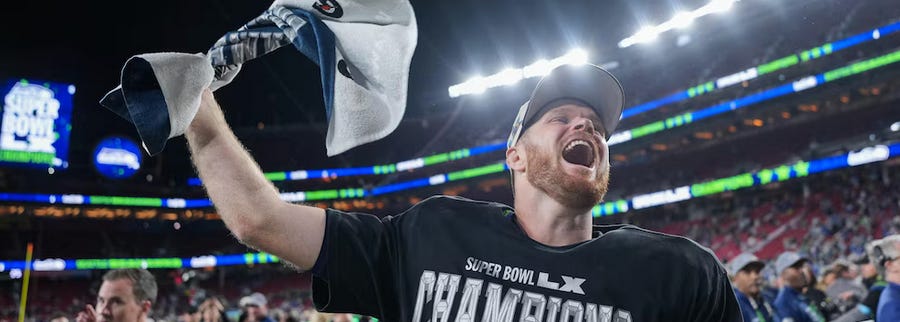
Sam Darnold was a bust.
Drafted 3rd overall in a draft class that included future MVP QBs Josh Allen and Lamar Jackson, he struggled mightily as a NY Jet. Three years of losing records and throwing almost as many interceptions as touchdowns left him adrift.
He got another chance in Carolina. Two years, not much better. They moved on.
One year in San Franscisco holding the clipboard as abackup.
Then…he seized his moment, leading the Minnesota Vikings to a 14-3 record. One bad playoff game and they decided not to sign Darnold but give another QB a try.
Now, with the Seattle Seahawks, he’s a Superbowl champion.
After the final whistle, confetti falling, Lombardi Trophy in hand, Darnold said something that stuck with me: “As long as you believe in yourself, anything is possible.”
The “Bust”
We often talk about resilience, being tough, bouncing back. And the cliches are true. It matters a whole lot. But saying we need a short memory and to have confidence are much different than being in the arena, being beat down, have everything around you, including talent evaluators that matter, telling you that you aren’t good enough…and somehow keeping the faith.
It’s hard to not become the thing we’re labeled.
Once applied, labels have a way of becoming the whole story. Especially when they involved failure. As Scott Sandage outlines in his book Born Losers, starting in the 19th century, our language shifted from “I failed at…” to “I am a failure.” Failure moved from an event to a representation of our character, a label that reflected who we were.
This simple shift in our story, ironically, pushes us not toward a story of growth but one of prevention and fear of failure. This internalization causes us to hand over power of our self-worth and sense of self to others.
That’s exactly what many in football did to Darnold. They turned an event—struggling on bad teams, in systems that maybe weren’t the right fit—into an identity. He wasn’t a quarterback who had been put in difficult situations. He was a bust. The label stuck, and everyone else moved on.
Everyone except Darnold.
Writing Your Story
Everyone’s got a story they tell themselves. It’s how we make sense of the world. And it guides how our brain readies itself for threats and challenges. And failures take up the largest sections of that book. For good reason, we feel them viscerally.
But too often, we hand over the writing to someone else. Your coach said you weren’t tough enough. Your boss said you weren’t ready. The internet decided you were a bust. We can see it when coaches label athletes “headcases.” It absolves the coach from doing the hard work to figure things out. And it cements in the mind of the athlete that they just don’t have the mental fortitude to make it.
If you hear it enough, you start to believe it. You internalize someone else’s narrative as your own. You stop being the author and become the character.
The people who break through? They take the pen back.
As I wrote in my recent book, our story needs to make sense. Not perfectly. But when there’s discord between the story we tell ourselves and the inputs coming in, we’re left with a choice. How do we fit these two pieces together? When they don’t fit, we experience what researchers call a disruption of meaning. We get desperate to make ourselves add up. To restore some sense of order, even if it means deluding ourselves.
Most people resolve this tension in one of two ways. They accept the label, internalize it, and let someone else’s verdict become their identity. Or they try to make sense of the messiness. Not by ignoring the failure, but by integrating it into their own story in a productive manner.
Darnold chose the second path. When asked about his years of struggle after winning the Super Bowl, he didn’t erase those chapters. He said: “The days in New York, the days in Carolina—those were part of my journey, and they’re part of my experience—and I loved every single part of it. Yeah, there were some lows that sucked, I’m not gonna lie to ya… but I learned so much from that.”
He didn’t change the facts. He changed the meaning.
We craft narratives to make sense of our experiences, to find coherence by connecting the past, present, and future. We all walk around with stories that help guide our behavior and make sense of our experiences, but we ultimately play a role in how we tell those stories. How do we make sense of our failures? Do we freak out, compartmentalize, or accept and integrate them?
In studying how people navigate life’s challenges, psychologist Dan McAdams found that how we tell our stories matters. Those who tell redemption stories, where we go from a low to a high, turning our suffering into something positive, score higher on measures of well-being than those who tell “feel good” stories, where everything is generally pretty good. The old adage that the bad makes the good better holds true. But in further research by psychologist Jack Bauer, it wasn’t the sequence that mattered the most. It was the themes in those stories.
Bauer and colleagues found that growth themes mostly explained the higher levels of well-being. There needed to be signs of exploration and expansion. But not from a materialistic or outcome focus but, according to Bauer, from a more holistic and humanistic viewpoint. Growth themes lead to “strengthened senses of self, relationships, and philosophy of life.” It’s about having a secure sense of self but also being willing to explore. It’s making sense of suffering, which sometimes means closure through acceptance and other times through change. As Bauer concluded, “It appears that well-being has more to do with interpreting meaning in one’s life than with interpreting life as turning out well without a stated reason.”
That’s Darnold’s story in a sentence. His well-being—his resilience—didn’t come from things turning out well. For seven years, they didn’t. It came from finding meaning in the struggle. From finding growth themes in what everyone else saw as a cautionary tale. Years after his initial research, McAdams summed up what they now know: “It’s good to tell life stories in which the protagonist is agentic, is engaged in warm close relationships, is resilient and forms a coherent narrative. Still, you can’t just make those up. Lived experience needs to resonate with the story.”
Own Your Story
Failure can eat away at your soul. It can be uncomfortable and make you miserable. It makes us feel that way because we’ve ingrained the wrong story—a narrative that success defines us, and what we do is the outlet in which we feed that monster. To reach our potential, we need to let go of the success narrative, put space between what we do and who we are, and realize we are worthy.
That advice might sound cliché. It might cause you to tense up, resist, and start talking about how “winners” must hate losing. That’s the monster talking. The thing that’s got a hold of you, that convinces you that your irrational tantrums after failure just mean you care. Sometimes, to achieve your potential, you just have to let it go.
Darnold talked about adopting what he called a Jerry Rice philosophy: “Jerry Rice has a quote… he never had a perfect practice or a perfect game. It’s not always going to be perfect. That’s why everybody loves this game… because nothing’s always perfect. And it’s about how can you move on from mistakes.”
Learning to lose well means changing your story. It means lowering the defenses and the sensitivity to failure so that it isn’t a threat. It requires learning how to move through the phases of fear or loss, first to go from stressed and protect mode to recover and restore, and then from recover and restore to learn and grow mode.
Darnold’s own words echo this perfectly: “I feel like, even mentally, I handle it a little differently internally than I used to. Because I realize it is part of the journey and it is part of who I am.”
He didn’t sugar coat the disappointment. He folded those failures into a larger, more coherent story about who he was becoming.
Losing Well
If we integrate, process, and move forward, failure can bring clarity by a “stripping away of the inessential.” Failure frees us to take back control, own, edit, and rewrite our story, instead of giving over that power to someone or something else. When we hand over that control, the thing wins. When we lose poorly, we’re giving over control and cementing the threat-prevention loop. We’re telling our brain and body to get stuck.
Darnold refused to get stuck. He said: “You can just get basically blackballed into saying, ‘Well, you’re not a starting quarterback.’ For me to be able to do what I did, go through the early trials that I did, and be able to come back from that… I think that’s really what it comes down to—I’ve always believed in myself.”
We all carry labels that someone else gave us. The kid who wasn’t smart enough. The employee who wasn’t ready. The athlete who was a headcase. Those labels feel permanent because we treat them that way. We confuse a bad situation or fit with a declaration of our overall ability and potential.
I’ve been there. I’ve worn many labels: phenom to failed phenom, whistelblower, coach, writer. At each step, the world tried to define me. To fit me in a box, and tell me I was only this thing…or that my failures meant I couldn’t be anything else. And quickly, I realized, it was all nonsense.
As the author Michael Lewis once told me when I was sitting on stage with superstars Sue Bird and Brad Stevens, “If you ran 3:5x instead of 4:01, I don’t think you’d be sitting on this stage.” And he’s right. The thing that gave me inordinate amounts of pain at the time, paved the way for everything to come.
Lived experience needs to resonate with the story. And sometimes the story other people wrote for you simply doesn’t match the truth of who you are and what you know. Success derives its power not from the result itself, but from the transformation we undergo during our journey toward it.
Darnold’s transformation wasn’t the Super Bowl. It was every morning he woke up after being cut, traded, or benched and decided that someone else’s verdict wasn’t his story. The Super Bowl was just the last page of a chapter that he’d been writing for seven years.
The question isn’t whether you’ve failed. You have. We all have. The question is who’s holding the pen.
Take it back.
-Steve
Great piece. Thanks