

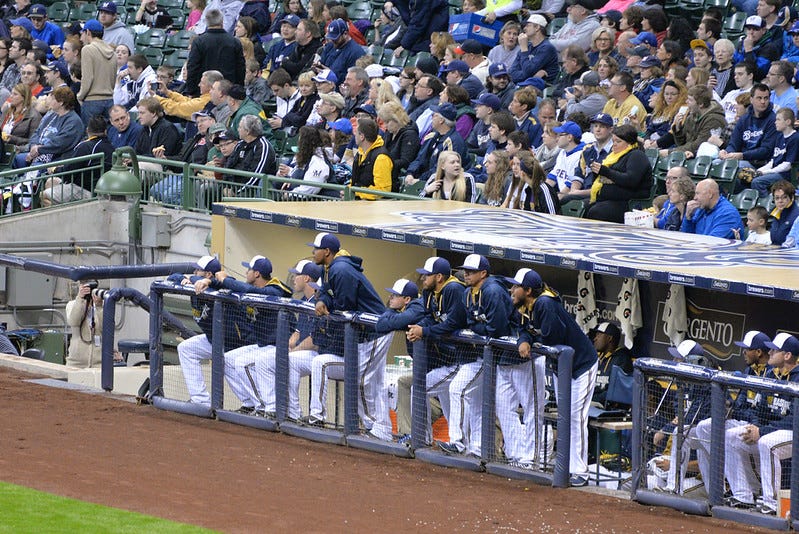
“They may have a bunch of Hall of Famers, but we’ve got a bunch of gamers. And the gamers won this week.”
The Milwaukee Brewers just advanced to their first World Series in 44 years. They’re a small market team, ranked 19th in the MLB in payroll. They beat the Dodgers, who spent more than twice as much on their roster. And they’ve been putting on a masterclass of leadership and culture, showing us what it actually takes to compete in the arena on the biggest stage.
1. Make it Bigger than Yourself
In the clubhouse after advancing to the World Series were the requisite champagne bottles for celebrating. Their labels carried the names of every player who had ever played a playoff game for them. There was Robin Yount, 1981, Curtis Granderson, 2018, and a slew of others.
For the National League Division Series victory, the labels had every city in Wisconsin. It’s a small detail, but one that sends a bigger message. That it’s not just the 26 guys in the clubhouse right now that you’re doing this for. It’s those that came before you, the entire state of Wisconsin, and more.
Erik Kratz, who only played for the Brewers for one year in 2018, saw his name on the bottle and said that it sent a clear message: “Everybody matters.”
The clubhouse crew that makes these is led by a man who has been with the organization since the 1990s. He’s seen the highs and lows, and everyone who has tried to make a difference during those years.
When you’re playing for something bigger than yourself, it allows you to dig deeper. Our brain has a kind of governor, an alarm that tries to shut us down when we’re in the depths of fatigue and discomfort. Its job is to protect us, to keep us from doing something stupid and pushing too far when we shouldn’t. But it’s generally overprotective and goes off too soon.
When our motivation comes from something deeper than just the reward or accolades, that governor loosens the reins. It allows us to push a bit further. It’s why marathoner Conner Mantz dedicates each mile of the race to a different person.
But it goes deeper than just motivation. It’s about belonging, one of the most powerful forces we experience. When we feel we belong, we not only fight a bit harder, but it turns down that alarm. It’s why researchers find that the threat centers in our brain light up less when we have a loved one holding our hand when we encounter something that we’re afraid of. It’s why we judge weights to weigh less and distances to be closer, when we’re with our friends.
Belonging makes us feel more capable. It allows us to take the risk, because failing isn’t existential. You know, win or lose, your brothers and sisters will still have your back. We can play to win instead of living in protective mode, because we know we have backup. That the guy or gal next to you will be there to pick up the slack.
You don’t build “everybody matters” with cheap slogans or trust falls. It’s a culture that is established brick by brick, the in-between moments, idle chit chat on road trips, and clear standards from the top down.
It’s built by treating people with respect, dealing with the messiness of having a group of humans doing a job with an understanding that it’s bigger than them.
It’s the subtle reminders, like having Robin Yount 1981 on a champagne bottle. Or dedicating the win to Mr. Baseball, Bob Uecker, their longtime announcer who passed away last year.
2. Choose the Right Frame
The Brewers easily could have been the ultimate underdogs. The team with fewer stars, going against the Ohtani, Betts, and the other all-timers that the Dodgers had. But their manager intentionally chose not to use it.
Last year, the Brewers got swept by the Dodgers in the playoffs. Their manager Pat Murphy’s framing backfired. “I’m sorry I played that underdog card. I probably shouldn’t have played that, used that as an excuse for why we didn’t play well…I don’t care who the underdog is. I don’t care who the favorite is. It’s about getting in the ring and fighting it out.”
Our frame has to match the moment. An underdog story can be energizing. It can dampen down the pressure we feel, and allow us to be the scrappy competitor fighting to prove people wrong. But it can also cause us to default to “we aren’t in their league.” If all the signs start showing us that we may not have a chance, our brain starts to believe it. We’re the underdog can quickly become: we don’t belong on the same field as them.
That’s the nuance of leading in the arena, everything works and doesn’t. An underdog framing can be motivating, allowing us to take bigger swings. But it can also cause us to check out. The best leaders can read their team. They know how to frame success and the competition correctly to give their team a shot. And that frame can shift from game to game.
3. The Results Can Get in the Way
Two years ago, after hitting .199, Brewers first baseman Jake Bauers was ready to retire. A few days after he told his agent about his plan, he found out his wife was pregnant. As he relayed, he changed his mind partially because he knew they’d need health insurance. (Think about that for a moment…)
Now, he’s the NLCS MVP, after a career year. During the NLCS he had three moments that changed the series for the Brewers. In Game 2, with two outs, he had a 12 pitch at bat against one of the Dodgers’ star pitchers. He ended up getting a walk, which then led to Christian Yelich hitting a go ahead single. One of Bauers teammates said“It’s a selfless at-bat.”
In Game 3, Bauers hit the go-ahead 2-run homer on the 11th pitch of an at bat. And in game 4, down 4-0, he hit a two run double to cut the lead in half and keep the Brewers in the game.
His explanation for the turnaround: “I came into this year feeling like there was really only one person holding me back, and that was myself. I stopped caring about results. I started caring about competing.”
It sounds absurd. Isn’t the result the point? When we focus too much on the result, it pulls us away from taking the actions that actually help us get there. An outcome obsession also activates more avoidance motivation. Our brain goes into protecting our ego mode because we’ve told it the results matter so much.
We’ve got to let go...just enough, to get out of our own way.
4. Quiet Your Ego
Pat Murphy got his first big-league managing job at 56, as the San Diego Padres’ interim manager. He lasted 96 games, with a .438 winning percentage, and was let go. His brutal realization was that, “I did everything wrong five times… My ego was involved a great deal more than it should have been.”
He then spent 8 seasons as a bench coach, and only got another opportunity at 65. Over the past three years, he’s been Manager of the Year twice, and led the Brewers to a .603 winning percentage. All with the simple motto of: “You keep trying to find a way.”
He’s the perfect example of combining standards and care, at the same time. Far too often, we see leadership as an either/or. You are a hard-ass or a players’ coach. But Murphy encapsulates what the best research on parenting and coaching tells us. You need both.
Murphy said us as much, quoting his mentor Harvey Dorfman: “Parenting is love and discipline. And as they get older, the amounts of love and discipline get pretty close… But never let that discipline get over the love.”
He’s learned it from his early years coaching at Notre Dame. Where although he had some success, he swung too far towards discipline without the necessary love and care. “It made me look like a good coach, and I wasn’t. Please believe me, I wasn’t. I was a tyrant.”
He sat out a former MVP, Christian Yelich, for Game 1 of the NLCS because he liked the matchup better with another player in there. “It’s about our team and what’s best for our team today. You kind of look at matchups and you look at history.”
After rookie Cooper Pratt didn’t get a bunt down he was asked to deliver, and then failed to hustle on a pop-up, Murphy benched him, explaining “You’ve gotta be locked in if you’re going to play at this level.” But he also said, “I know who this kid is. He’s a great kid. So it was hopefully a good learning experience.”
You can see that Murphy has built the trust to make those moves. Just listen to some of the players on the team talk about him.
Andrew Vaughn: “He cares. His passion is unbelievable. He’s gonna tell you how it is. He’s gonna walk up to you, man to man, and I respect that so much.”
Blake Perkins: “He’s one of the best guys around here, and he cares deeply for all of us in here.”
—
The Brewers won with a manager who dropped his ego and upped his level of love and care. A star player who dropped the results story. And a team that ditched the underdog role, and decided to put the emphasis on competing together, for something bigger than themselves.
That’s what a gamer is. Someone who tells the right story for the moment in front of them. It’s not some fake alpha BS that looks good on the internet. It’s not some tyrant who doesn’t do the requisite work to build trust that comes from a place of genuinely caring about those you’re leading.
A gamer is someone who finds a way to show up and keep competing, despite the discomfort, fear, and everything else that goes into stepping into the arena.
-Steve Magness
Research to Go Deeper:
Students who adopt a self-transcending purpose persist longer.
Threat centers quiet when a loved one holds our hand.
Hills look less steep when a friend is with you.
The “Underdog effect” and how it can help and hurt.
Outcome obsession can activate avoidance motivation.
Dumb Workout of the Week (And how to do it right):
I’m testing a new segment, where I take a workout suggested by someone on social media or a podcast, and breaking down why it’s good or bad. This isn’t meant as a call out, but as a fun way to help readers learn. So I won’t be linking to whoever said it, to minimize the outrage culture. So without further ado…