

Reading may be on the decline, but it’s one of the best investments that you can make. We’re increasingly seeing that our brain adapts to the information we consume. If all we consume is short form video and piffy one-liners, we start thinking in a similar way. The antidote? Consume long form content. Make your brain wrestle with an idea.
So in that spirit I wanted to offer 10 books that I read this year that made me do just that. It’s an eclectic list, a mix of science, history, sport, and smart self help. But each left me with mountains of notes and ideas I was rolling around in my head on runs or walks afterward.
Please let me know what additions you have in the comments. I’d love to expand my reading list.
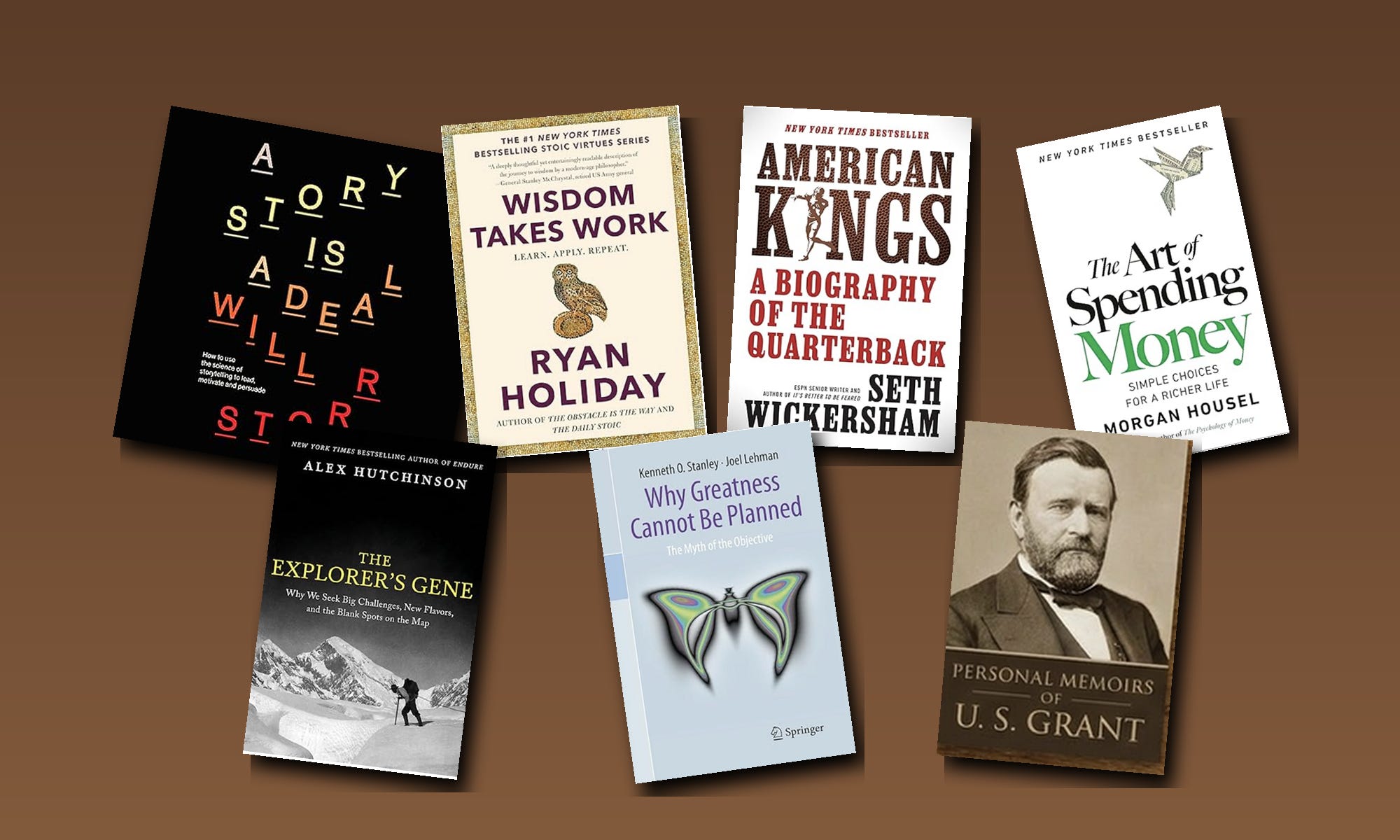
The Explorer’s Gene by Alex Hutchinson
In Endure, Hutchinson took the science of fatigue in a book that has now become a classic. In his latest, he asks the question of why do we take on new challenges and seek the unknown?
It’s never been easier to live an exploration-free life. Our phones deliver the illusion of novelty without the growth that real exploration provides. We get the dopamine hit without the struggle. What Hutchinson argues is that our lives are more productive, more meaningful, and more fun when we sometimes ditch the maps and find our own way.
It’s a kind of love letter for trying new things and sometimes getting a bit lost.
Wisdom Takes Work by Ryan Holiday
Holiday continues his exploration of Stoic philosophy, but this time with a sharper edge. Of course, there’s plenty of Seneca and Marcus Aurelius, but this addition adds something more. He takes on topics that quite honestly most authors would shy away from in fear of alienating their audience.
You can see it best in his unpacking of Elon Musk. Holiday outlines his brilliance, the overcoming of so many obstacles, but also how the things that fueled those achievements contributed to his unraveling, as they weren’t counterbalanced with perspective or wisdom. It’s our modern Howard Hughes.
I also loved his treatise on Lincoln. Well worth a read, especially in our current climate where social media is rotting our brains.
The Art of Spending Money by Morgan Housel
Housel does what he does best: takes a topic we think we understand and reveals how little we actually grasp.
The book explores the gap between what money can buy and what actually makes us happy. Housel argues that most financial mistakes stem not from bad calculations, but from using money to solve problems it can’t fix—or to signal things we don’t actually value.
American Kings by Seth Wickersham.
There’s something about the quarterback that captures our imagination. It’s the general on the field of play. The one player who can never be anonymous surrounded by a bunch of guys who we have to look at the name on the back of their jersey to identify.
Wickersham takes us through the mystique. From managing the unreal expectations of Arch Manning to what in the world you do once the lights are off, it’s a fascinating glimpse into the psychology of a position that demands both supreme confidence, but the humility to do the work.
The Personal Memoirs of U.S. Grant
Grant wasn’t the drunk failure of popular imagination. He was a man who failed repeatedly, then rose to save the Union and fight for civil rights during Reconstruction.
In Grant’s own words, he traces his journey from a struggling leather shop clerk to commanding general to president. We get to see what made Grant special, a kind of quiet resilience. Grant didn’t have the charisma of Lincoln or the brilliance of Lee. What he had was persistence and moral clarity when it mattered most.
Conquerors of Time by Lynn McConnell
McConnell takes us back to the 1930s when the mile was king.
During the Depression, track and field exploded in popularity. And at the center of it all stood a handful of men chasing the same prize: supremacy in the ultimate event.
The book traces the rivalry between New Zealand’s Jack Lovelock, America’s Glenn Cunningham, Italy’s Luigi Beccali, and Britain’s Sydney Wooderson.
It’s an era that is largely forgotten, even among track aficionados. The coming War and then the chase for the 4-minute mile that followed overshadow the era now.
What makes the book special is how McConnell excavates Lovelock’s mind. This was an athlete who treated racing as intellectual problem-solving. He studied muscular relaxation, mental composure, pace judgment.
Why Greatness Cannot be Planned by Kenneth Stanley and Joel Lehman
This one challenges everything we think about goal-setting.
Stanley and Lehman argue that ambitious objectives often backfire. The more specific our goal, the more we constrain the paths that might actually get us there. Their alternative? Follow “interestingness.” Pursue novelty. Let curiosity lead rather than forcing a predetermined destination.
I’m biased, but in a world that often tells us to set SMART or big hairy audacious goals, this one resonated deeply. It fits what I’ve seen in my own career, both in sport and writing. The goal helps at first, but eventually it becomes a path constrainer. It locks us into only seeing the one objective, and not all of the other paths we could take.
A Story is a Deal by Will Storr
The book reveals what really drives human behavior: our relentless pursuit of connection and status. We want to belong to groups. We want those groups to value us. Stories work because they promise both.
Once you see this pattern, you can’t unsee it. Every advertisement, every political speech, every pitch—they’re all offering the same thing: become who you want to be, and I’ll give you what I’m selling.
We live in stories where identity matters more than survival.
Drawing on neuroscience, evolutionary psychology, and decades of research, Storr argues that every effective story is an implicit transaction. The audience gives you their attention. In exchange, they expect something—specifically, they expect you to help them become who they want to be.
As if Running on Air: The Diaries of Jack Lovelock
This one is for the diehard runners. It’s Jack Lovelock’s personal diary and training log. It’s a running nerds dream. A glimpse into how he trained to become Olympic champion, but even more so how he looked at racing. I just loved the parts where we see him struggling with anxiety and pressure, or figuring out how to peak at the right time.
And of course… Win the Inside Game
That’s right. My latest book came out in February. It’s all about how to find a sustainable path to achievement. I go deep on how to navigate pressure, the role of your identity in making you fragile or resilient, how to handle defeats or moving on from your passion, how to nurture talent or prodigies without leading to burnout, and make more. It’s the book I wish I had as a teenager achieving success in running or when I started my writing career.
If you haven’t read it yet, consider doing so. The reception has been fantastic from those who have, and it’s currently 44% off for the holidays! (And my prior book Do Hard Things is 55% off. Both make great Christmas gifts!).
Thanks so much for reading. Let me know the best books you read in the comments below!
-Steve Magness
I really enjoyed The Explorer's Gene and am currently reading Do Hard Things (a little late to that one, but it's great). Any fiction you'd recommend?
Thanks for sharing, Steve. Here are mine: https://jamesrmarshall.substack.com/p/my-books-of-2025