

I just experienced one of the more surreal moments in my life. One moment I’m tweeting about a research paper on exercise. The next, I got called a R-word by Nassim Taleb.
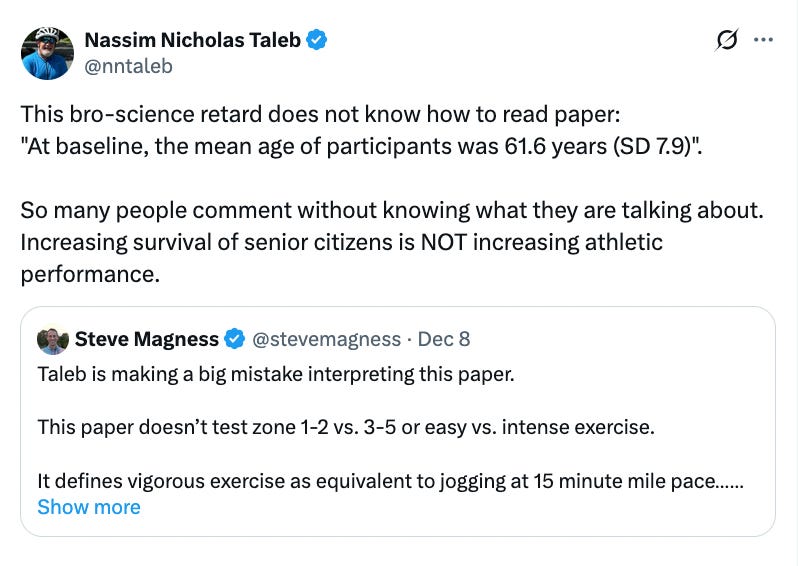
The argument was over a new paper that’s been making the rounds in social media and podcast world. The headlines all went something like this: “Vigorous exercise is 4-9x more impactful than moderate exercise!” Taleb extended that further, stating, “While for athletes Z1-Z2 may be beneficial (they saturate high intensity), for vanilla citizens v. high intensity is >>beneficial, 1 min Z3+> 4 min of Z2, up to 9 for T2 diabetes.”
He tied physiological zones to the researchers classification of moderate and vigorous.
But what did the study actually find?
Let’s unpack the study briefly. They had between 3 and 7 days of accelerometer data on over 70,000 older adults. And then utilized follow up data to see what happened to them in terms of disease and health for 8 years.
The accelerometer data is the key. To keep it simple, they used this data to classify intensity of daily activity into three buckets: light, moderate, and vigorous. They did so using the MET (metabolic equivalency) framework. A fancy word for roughly classifying the VO2 demand of an activity. In this case, they used a classification system that relied on two steps: first deciding whether they were standing, walking, or running. And then, based on how quickly the accelerometer was moving.
Before we get to what this actually means, let me pause and ask a question? What does vigorous exercise mean to you? A hard interval workout, sprinting, a fast jog? What comes to mind…?
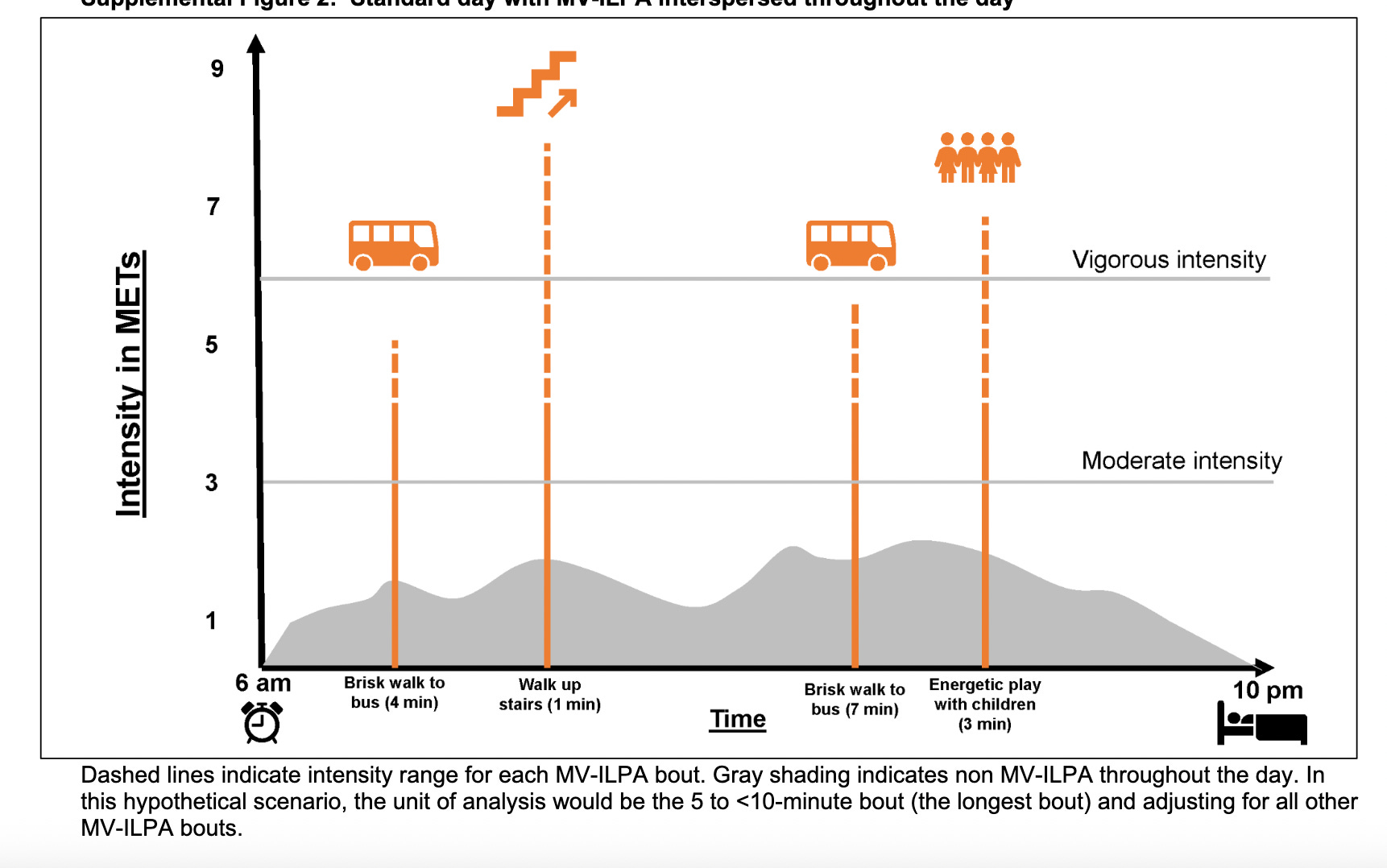
In this study, it means a fast walk, playing with your kids on the playground, walking up stairs, or a jog at 15 minute mile pace. Of course, it means anything faster or harder than that too. Which is the first important point. In this context, vigorous isn’t defined the way many assume. It literally means anything that we could think of as “exercise.” And even includes some things that many wouldn’t think of as exercise.
In addition, it’s an absolute measure of intensity. Meaning it doesn’t matter whether a slow jog barely raises your heart rate or gets it near maximum, if it’s a jog it all counts in the same category.
For moderate, it includes things like: walking to the bus, vacuuming the carpet, making the bed, and all sorts of other household chores. Light activity is essentially when we’re standing around or going on a slow walk.
Which brings us to the first important point that I tried to get across to Taleb and others.
The researchers weren’t looking at training zones. And we can’t extrapolate the above data to training zones for a few important reasons.
First, the category definitions differ greatly. One is absolute (MET based). The other is relative (zones).
The MET based one calls making the bed or vacuuming the floor as moderate. It include one big category of vigorous that includes everything from a fast walk to all out sprints.
The other doesn’t even start until you start exercising. It doesn’t include making the bed. That’s zone 0 for most, even older folks.
You simply can’t map that onto physiological based training zones. The categories are too broad and different. Even if we made some broad assumptions and said, well these are older folks, so maybe for enough of them a fast walk is hard, maybe at zone 3, it still doesn’t work. Our moderate training category comparison doesn’t fit. We can’t assume that making the bed spikes their heart rate high or long enough to be in zone 2 or whatever.
They are just two different categorization systems. One meant to track daily activity. One that is relative and meant to track an individuals response to exercise.
Second, zones are meant to classify time spent at a specific physiological level. We say you’re in zone 3 because your lactate levels are at around 4mmol or your heart rate is at 85% or whatever for long enough.
In the accelerometer study, they evaluated time spent at certain activity levels per day. So if someone does fifteen different 2 minute fast walks throughout the day, it counts it as 30 vigorous minutes. But with training zones, we wouldn’t count it that way. Why? Physiology. Our heart rate, VO2, etc. needs time to rev up. In fact, even if I went straight into a hard run right now, my aerobic system would need about 90 seconds to reach max.
So in the 2 minute example above, we’d barely be in a physiological zone before we stopped. It’s why we classify the following two workouts differently, even though they are at the same pace and total amount of time spent at that pace is the same:
-30 minutes at 5:30 mile pace (let’s say: zone 3)
-30 x 1minute at 5:30 pace with 3 minutes rest between. This workout would include the majority of the time spent in zone 2ish
So what?
We’re left with a situation where folks confused activity and exercise. Zones categorize the latter. The MET/moderate/vigorous classify the former.
We have a situation where most peoples conventional definitions of vigorous don’t match the research based definitions. This leads to miscommunication. Where someone hears, “Oh this says vigorous exercise is the key, so I need to go to my Crossfit gym and smash some intervals.” When that’s not what this study says what so ever.
Both categories are useful. In this study, it tells us that daily chores aren’t as efficient, or aren’t enough to give us the benefits of moving a bit more. So in this case, sure going for a brisk walk or a slow walk is 4-9x more efficient at delivering health benefits than making your bed. But…that doesn’t mean we extrapolate that out to: we all need to do hard intervals all the time over easy running. That’s not what this study looked at.
That’s important. It tells us the message can’t just be slowly walk your dog, but you need to deliberately move: play with your kids, go on a job, speed walk, whatever it is.
But it doesn’t tell us about what exercise is best for health or longevity. That’s not what the researchers studied. They looked at activity, not exercise.
The sad part is, we have plenty of research that does tackle this question. That looks at training intensity zones or types and the impact it has on general fitness and health. And the conclusion is almost always the same:
First, anything helps if you are sedentary. Literally any exercise. Fast, slow, long, short. Just get moving. That’s the number one thing. Don’t get lost in the details. They don’t matter because truthfully, you’re so out of shape that all “zones” kind of blend together. You’ve got to get fit enough to train.
Second, after we get moving, a smart mixture of everything works best. Each intensity type helps in a slightly different way. There’s overlap, but each activates different pathways in different amounts. So we need a bit of everything.
What’s the best mixture depends on your goals, but history and science point to the same thing for health and longevity: a good amount of easy, a bit of moderate, a spice of “hard” and repeat for months and years on end. The last part being the most important part.
No, there isn’t some magic formula or workout. No, Tabata sprints or the Norwegian 4x4 isn’t going to give you the best of everything. There is no Pert Plus of workouts. The best program is a balanced one that is sustainable for YOU.
Somehow, this explanation led me to getting called names by one of the world’s biggest authors. It makes me sad. Because my hope is that we can disagree on substance, without reacting like a toddler hurling ad hominem attacks.
The internet has ruined far too many brains. Maybe the answer after all is we need more brisk walks…just not for our health, but to get us outside, in the real world, preferably with friends, so we don’t lose our minds screaming horrendous words on the internet…
Don’t forget to touch grass on your walk… that’s probably the most important lesson.
-Steve
Anybody calling you "bro science" is hilarious, you're the opposite. He's out of his element
Only 3 certainties in life: death, taxes and being insulted by Taleb.