

The IOC just announced their policy on DSD (Differences in Sexual Development) and trans athletes in the female category. Reactions have been all over the place, depending on which side of the aisle you fall on. As this issue has been highly politicized on all sides. I want to skip the outrage and go with the scientific facts and the history of why we got here. My hope is to give you a brief primer that helps you understand:
How to divide sport by sex has long been in an issue in athletics. No one serious has ever questioned that sports should be separated by sex, it’s how to define the line where the debate lied. We’ve gone from informal scrutiny to some barbaric and invasive practices of “nude parades” to using genetic testing, and everything in between. It’s a long history, with many poor turns. But our current situation started in the 1990s, when in 1996 the IOC Conference on Women in Sport issued a declaration “to discontinue the current process of gender verification during the Olympic Games.” Three years later, they did just that, citing that wide spread testing wasn’t really needed and that cases would be handled on a more informal and case by case basis.
Fast forward a decade and that’s where the modern issue started. With no sex testing, DSD athletes started to rise to prominence in athletics. Most notably Caster Semenya who came on the world scene in 2009. At first there were murmurs and discontent under the surface of someone dominating the 800, but it came to its head when at the 2016 Olympics, DSD athletes swept the Olympic 800.
We eventually learned that these athletes had the single biggest performance boost we can get, androgenization. Something that none of their competitors could ever have.
Let me tell you, it was a messy time period. Athletes who spoke out got torn apart in the media. Coaches who spoke up shot down.
But it pushed the debate to the forefront and started us down a path of trying new policies to find solutions.
Before we continue, it’s important to put in context how big a boost males get from simply being males. It’s a larger boost in performance than if you were Lance Armstrong or Barry Bonds and hopped up on all the performance enhancing drugs known to man.
That’s how large an effect it has. It’s why from 100 meters to races hundreds of miles long, the performance differential is generally 10-15%. Even larger in some strength events.
Now, a mistake folks often make is that this doesn’t mean all men beat all women. There is substantial overlap. My wife is going to better than 99% of men in distance running. That’s because she’s really good.
But at the top of the top, the gap is insurmountable. The top women is always at a significant disadvantage.
And every male gets the performance boost. For some, that 10% jump just takes them from awful to kind of awful. But they still get a performance increase that their female counterparts don’t.
We can see it in the athletic data and the progressions of boys and girls. Depending on the event, there is a small but significant gap between performance even at early pre-pubescent ages (This partially has to do with boys receive a surge in androgens pre and post birth that starts the differences/trajectory). It’s why the age group world records for boys in track are almost always a few percent faster than girls. But at puberty, that gap explodes.
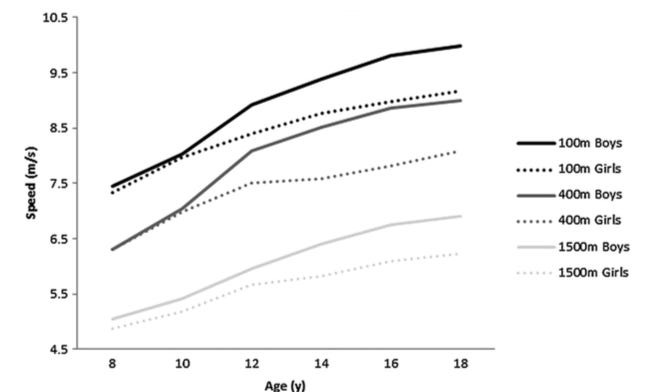
As the outrage mounted, and the clear performance differences showed, particularly in the 800, governing bodies and experts debated what to do about it. Women were losing millions of dollars in total to folks who had a male androgenization advantage.
We went from doing nothing with not much of a real policy to eventually instituting testosterone rules.
The thinking was, testosterone could be a surrogate marker. It also gave DSD athletes a venue to still compete in the male category. They could lower their T to typical female levels, and still race.
There were a few problems with this. First, it obviously only took into account CURRENT T levels. A large part of the boost comes from androgens through a lifetime. And the limit set for DSD athletes current T levels was much higher than nearly any female.
Second, this was challenged in court by DSD athletes. It was a long process that led to some strange policies along the way. For instance at first, the new rules only applied to some events but not others. DSD athletes couldn’t race the 800 but could do the 5k. This was the result of the need to definitively prove that every single events was impacted by testosterone. Which seems obvious and straightforward at first, but presented a very tricky scientific problem where you obvioulsy can’t run experiments, and the best data is performance data that for whatever reason isn’t accepted by the court as much. You can still see this today in a few studies on trans performance which have concluded that there is no difference, while neglecting to see that the only reason that conclusion was drawn was that the comparsion groups were unfair. In short, the studies compared really in shape females versus out of shape trans athletes. For more, you can see my piece on the Semenya from many years ago. It gives a good idea of where thinking was at the time.
The end result was tricky to regulate and be fair, and telling someone they had to have a medical intervention to compete came with ethical issues.
So that was eventually scrapped. At the 2021 Olympics you had DSD athletes win medals in events that weren’t yet in the prohibited list, causing a push to find a solution. I’m simplifying and summarizing years long backs and forth, obviously.
A year ago, track and field moved to the policy the IOC just adopted. They used the SRY test as a screener.
Why? It was simpler, straightforward and applied to all females, so their wasn’t a separate DSD and trans policy. It also put the dividing line for segregating sports by sex instead of a surrogate marker.
Now it’s important to note here that there’s been a lot of misunderstanding of the SRY test. It is not meant to be the definitive be all end all. It’s a one time screener. If it comes back showing a DSD, then athletes are allowed to do further testing to see if that specific DSD included androgenization or not. It’s why there is an exception for those with complete androgen insensitivity syndrome (CAIS). Why? because androgenization has little to no effect on them. So they do not have an advantage.
It’s also important that this policy applies to elites only. So a one time cheek swab or blood test for folks who have to provide drug testers a list of where they’ll be every single day of the year…isn’t that invasive or a big deal.
So what? I’ve seen this policy framed as immoral, invasive, fascist, and even nazism…
But the point is...it’s a result of 20 years of debate, research, and trying to figure out a solution to a tricky problem. Yes, it’s an issue that has been unfairly politicized. That sucks. I wish it hasn’t.
And yes, we should lead with empathy and understanding. Even if we think Semenya or whoever shouldn’t compete against females, we can have empathy for anyone going through a world wide media circus where their body is front and center. That’s a failure in governing bodies and policies. It should never have gotten to that point on a world stage.
Why is it important to separate sports based on sex?
Because it’s the biggest performance boost we could get. If we didn’t, there would be zero professional women athletes in an open category.
That’s how big the gap is. And I for one value and think women deserve the spotlight to compete and show off their hard work and talent. I’ve spent my life coaching women at the elite level to do so. And women’s sport is fantastic for so many reasons.
Also, you might hear people say it’s a ban. It’s not.
Every athlete still has a place to compete. You can do so in the category that matches your biology, in open events, or recreational events that this does not apply toA very rough analogy: Longevity guru Bryan Johnson can’t compete in the under 18 category no matter what age score his crazy age metrics say he is.
We have categories and classification to ensure everyone has a chance to compete. Yes, we pick what categories are important. But it’s hard to argue that sex isn’t a very important one.
And finally, of course policies for elites should be different than college or even high school sports. Competition still matters in these venues and we can’t ignore the performance differential. And in competitive sport we still need sport separated by sex but their are sensible solutions that doesn’t make it where every HS kid needs a cheek swab.
So there you have it. It’s been 20 years in the making. It started with DSD athletes with an androgen advantage winning championships and has evolved from there.
It’s not perfect. Nothing is. We’ve debated, shifted policies, etc. But lots of smart folks and researchers have been trying to figure out a just and fair solution for a long time. And this is a pretty darn good policy for balancing everything.
Hopefully, I’ve handled this with nuance, care, and rigor. It’s not an exhaustive overview, but hopefully it’s enough to show that these debates have been going on for a long time and came out of some performances that occurred in the real world.
-Steve
Thanks Steve. Athletics needs rational statements from people like you.
Basically, if a male and female are of similar age and train with the same duration, intensity, and frequency in the same sport, the male will always have higher scores on pretty much all the metrics Exercise Science, Physiology, and common sense uses to predict athletic success.
Enough, BS, let the girls and women be masters of their own commitment and hard work.
Ugggggg
Steve, I'm not an expert in these matters but after reading this article I'm also not clear on what the current policy is (is it the SRY test you mentioned?) and how that policy/test actually works.
Also, can you do more discussion on the studies that do/don't show performance differences between trans athletes? Since this is such a hot-button topic politically, those of us who care about the science (and implementing with empathy as you said) need to have access to better information.