

The World Cup is here! And with that excitement I want to tackle one of the most discussed questions about soccer on (American) social media: If all our best athletes played soccer, would we dominate?
The idea goes something like this, what if Lebron, Tyreek Hill, and all our best NFL and NBA guys chose soccer from a young age. To answer that, let’s turn to one of my favorite charts, and the one time I got to act like I knew something about soccer….
—
A decade ago I got invited to speak at coaches clinic put on by the MLS team the Seattle Sounders. As someone whose first love was soccer, I jumped at the opportunity, even though the last time I was involved with the sport was when I was 14. I gave a presentation that centered on individualizing training. I put up a picture of four different middle distance runners I coached at the time, all with similar 800m bests, but some who came at it from the 400m side running 46 second 400 splits. While others who were endurance monsters. Some ran 90 miles per week to get that 800m time, others ran 30 miles per week. My point was simple: most of soccer is like middle-distance events combining speed and endurance. But even within that frame, you need to know what kind of athlete you’re working with.
Fast forward a few years, and one of my favorite charts from research came out. It plotted muscle fiber types of well-trained athletes in a bunch of different sports. And where did soccer fall? What sport did it look like? Middle-distance running.
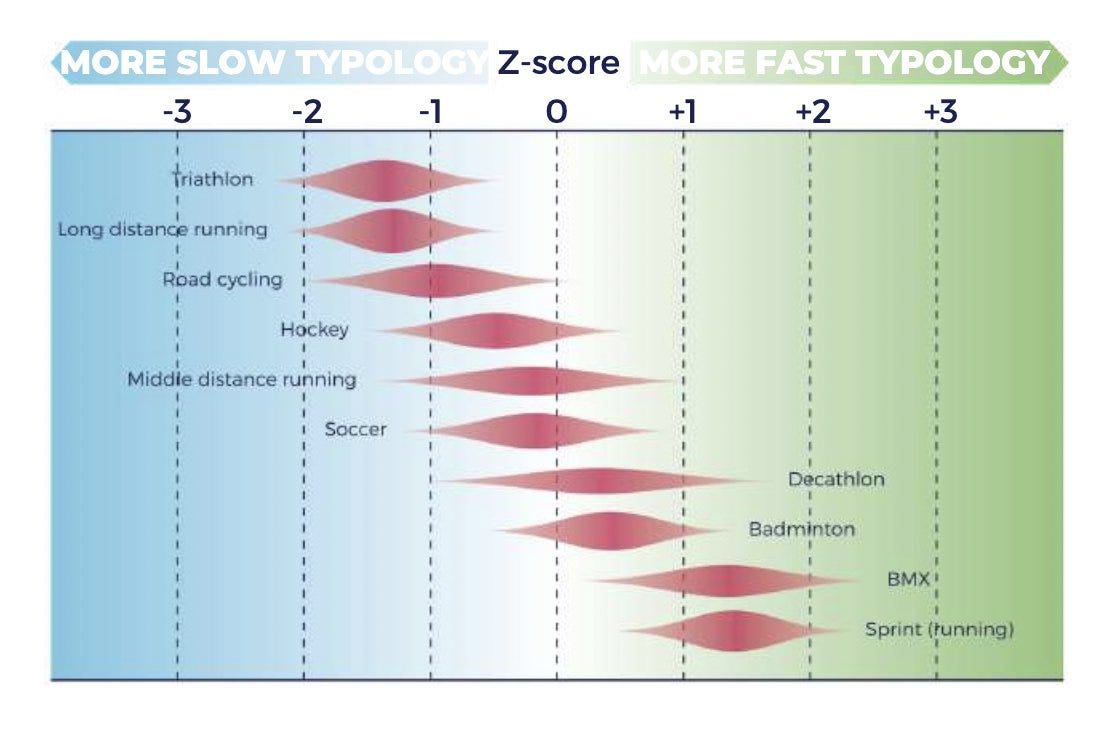
Which gets to point number one of the social media argument. Most American sports are games that favor speed. Our “athleticism” is based on 40 yard dash times and explosive events. But soccer isn’t that sport. It’s a 90 minute game with minimal breaks, where athletes cover miles with short spurts of fast running. Soccer is a game of endurance with some speed. Not speed with conditioning to recover.
Now, there’s always variation. Yes, of course there are a few sprint type athletes who make it. But by and large they are the exception. We can see this in further muscle fiber type data.
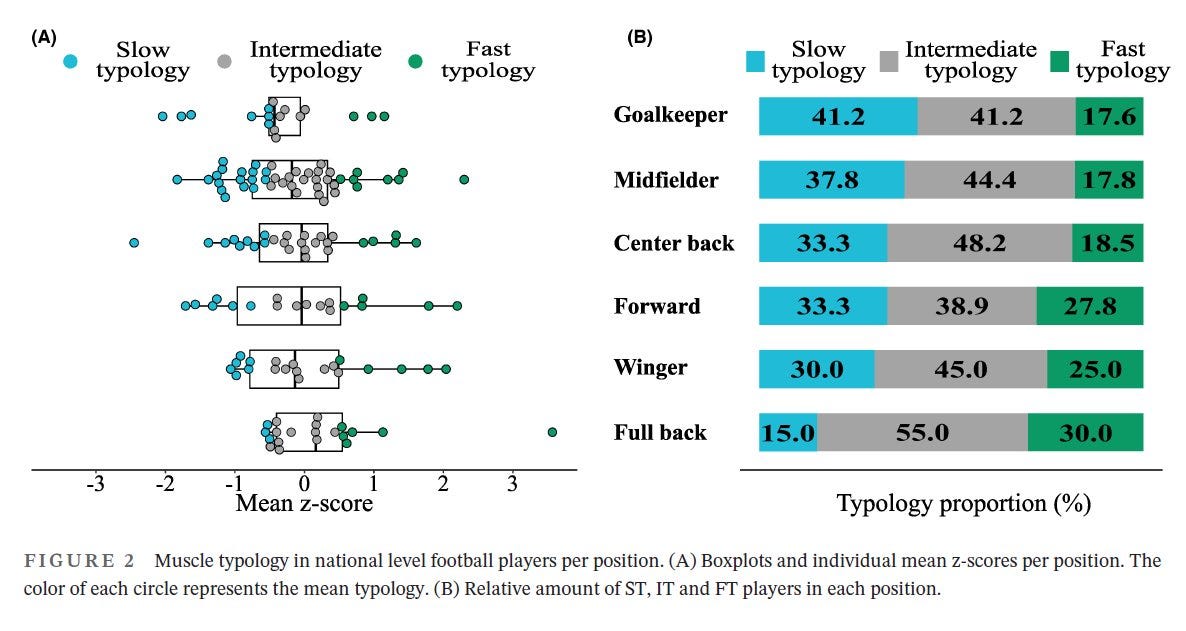
That’s why I like comparing it to middle-distance running. Yes, you’ll get an 800m guy who can split an astonishing 44 point for the 4x400. But he’s still got the endurance to run a 4 minute mile. He’s not Usain Bolt, or better yet, Carl Lewis who ran a pretty pedestrian 2:07 800m in the “Superstars” competition of the 1980s. For the pure sprint type, their endurance falls off fast…
We don’t have to look at muscle fiber types to get to this conclusion, just look at the soccer players who’ve run track. Every year in the NFL draft we get several players who’ve run the 100m in 10.0 to 10.4 in either college or high school. It’s not rare. In soccer, having a legitimate professional have anything remotely close is so rare that it’s noticeable. Yes, not as many soccer players run track in their later years as NFL guys, but we can see it with their early track times. (You likely aren’t running 10.0 at 18, if you only ran 11.5 at 15 years old for example.)
Just look at some of the fastest documented track times of soccer players (Note, there’s a lot of “I ran X hand time…” I’ve discounted those and went with verified times).
Nedum Onuoha ran 11.09 at 14 with a very strong wind (+4.4mps).
Gareth Bale claims he ran 11.4 at 14 in the 100m (and has documented 4:59 for 1,500 at 13).
Theo Walcott has a documented 11.5 at 14 (He’s claimed he ran 10.6 later, no results)
Marvell Wynne ran 11.05, 21.87 (+2.3 wind) and 48.01 in high school
Fakhri Ismail ran 10.59 for 100m.
When put against a solid sprinter in a 25m dash, Ronaldo finished a massive 0.3sec behind him, meaning (extrapolating a lot here…), Ronaldo is maybe a mid-11 100m guy.
I could go on, but if I’m honest after spending hours and hours tracking down all the claims, it’s pretty thin. Yes, there are legit sprinters like Adam Gemili who played youth soccer, but what we’re looking for is those who played professional soccer and have demonstrated track speed. The list is astonishingly slim.
Gareth Bale might be the best example. A guy who was known as a faster player, who had high MPH marks in the game, whose own youth track results show he was almost certainly a mid-distance runner with good wheels.
That’s the primary soccer type. And it makes sense, because the physiological demands of the game require endurance. If you were to pick one track event and said who would be best at playing for 90 minutes with lots of jogging around and 40-50 surges or sprints sprinkled in with relatively short recovery. Who are you picking? It isn’t Carl Lewis. He’ll be gassed. It’s someone like Cooper Lutkenhaus. Strong speed + strong endurance.
We also could just look at soccer’s best players and see that most of them are closer to the body type of a middle-distance runner than a sprinter. Messi is 5’7 145lb. Ronaldo 6’2 180. Mbappe 5'10" 165lb. Salah 5’9 155lb.
While they might need a little more muscle to jostle than their mid-distance counterparts, for the most part it fits the bill of Wanyonyi (5’7), Sedjati (5’10), Lutkenhaus (6’2), and so on.
Now, I want to be clear, we’re talking physiology here. Of course, the main component of soccer talent is their skill with the ball. That comes first. But too often the assumption is that freak athlete in one sport translates into freak talent in another sport. That can work if the sports demands are similar enough and they have the necessary skill. It’s why you sometimes see a former basketball player become an NFL tight end. But in soccer, the demands are different from most of what American team sports select for. Not entirely, but for the most part.
So what?
Maybe LeBron would make an exceptional goalie, I don’t know. But the super-tall basketball stars and the super-fast NFL guys aren’t the talent pool soccer selects from. If anything, it’s the high-motor guys with decent speed — the NBA guard who rips a 4:45 mile in conditioning like Allen Iverson, or the receiver who isn’t the fastest but never stops running, like Jerry Rice.
So when someone says we’re wasting our best athletes on the NFL and NBA, they’ve made a category error. They’re imagining one universal pool of “athleticism” that soccer just fails to dip into. There isn’t one. Soccer selects for a specific engine and a specific skill, and the two have to be grown together from the time a kid is small.
Fast enough to run by you. Not so fast your endurance falls off a cliff. That’s the soccer player. It’s not the same talent pool. It never was.
-Steve Magness
Thanks so much for reading. I’ll be bringing some content on the psychological side of the World Cup over the upcoming weeks, so be sure to subscribe for free to get it delivered to your inbox.
Nothing can really be argued here. Great article. I still think the larger point is, even if Allen Iverson selected soccer, he wouldn’t have grown up in the right soccer incubator, so the gains would be minimal. Lamine Yamal isn’t the same player if he grows up in Kentucky. Our best current men’s players in the squad, are the best largely because they grew up in soccer first households or grew up abroad…not because they are better athletes. Culture
Great article. The main issue isn’t, “How do we get our best athletes to play soccer.” It’s the youth sport culture we have in the US. It prioritizes specialization, winning, and enriching coaches.
We have to reverse it: get kids exposed to all kinds of sports, including putting a soccer ball at their feet, ban scoring until a certain age, and prioritize development in the community over large travel clubs.