

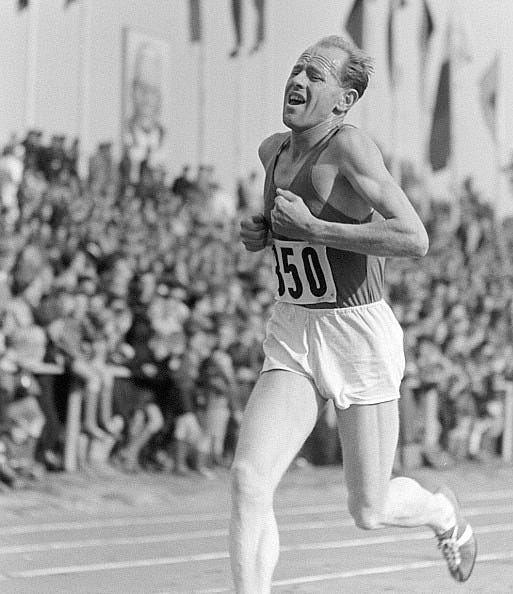
It’s that time again. The fitness world starts screaming that something is wrong, and everyone freaks out and goes in the complete opposite direction.
Recently, there’s been a backlash online against “zone 2” training, that ill-defined zone that basically means pretty easy training. For a while, zone 2 was the hottest thing; everyone was pushing it as the magic zone. This was preceded by a period when HIIT (High-Intensity Interval Training) was the magic bullet. Now, we’re making the inevitable U-turn away from zone 2 and back toward intensity.
First, why must we do this every few years? Can’t we just stop?
Second, I want to break it all down and give you the science and history of easy training: what it does, and where its rightful place is.
Hint: There is no magic zone, but you shouldn’t throw the baby out with the bathwater.
The Argument for and Against Easy Training
This argument is as old as time. If you go back and read a running training guide from the 1930s, you see folks arguing over long, slow walks or jogs versus doing 20x200m repeats every day. Throughout history, we’ve had coaching arguments on this exact topic: Gerschler vs. Holmer, Cerutty vs. Stampfl, Ron Clarke vs. the intervals, and on and on.
Early on, this argument was over the extremes, like it often is today. It was nearly all easy/moderate versus five days a week of interval training. That was what was being debated in the 1930s, ‘40s, and a bit into the ‘50s. But soon, we stopped debating the extremes. Everyone acknowledged that you need both. The argument switched from whether we should do lots of easy running or intervals to when each should be done and the exact dose.
Put simply, in running we stopped arguing about Zone 2 vs. HIIT in the 1950s. And for good reason. Through a historical lens, training works as a kind of natural evolution. It’s the survival of the fittest ideas. If you trace out the history of training, as I have in depth, you see that every generation takes what is normal and then experiments with its own variations. Some of those variations improve upon the training and are carried forward; some don’t and get thrown into the dustbin of history.
It’s not a perfect system. Sometimes we take wrong turns (looking at you, 1990s heavy VO2max training for high school kids…), but over the long haul it works really well. Why? Because performance is objective. Coaches adopt new models, and if a model makes a big enough difference at the high school, college, pro, and recreational level, it sticks around. If it doesn’t work, it tends to be abandoned.
So across history, all the variations of lots of easy, lots of steady, lots of intervals, and everything in between have been tried. What’s stuck around is:
Lots of easy, some moderate, a bit of hard to sharpen up, and occasionally go see God to realign perspectives.
The exact ingredients and proportions differ, and I’ll cover that at the end. But no one serious is running their best marathon, or even 10k, off 30 miles per week. No one serious is doing 5+ days a week of intense workouts. Everyone is building some sort of aerobic base, doing some amount of threshold or high-end aerobic work, and eventually building in two or so harder, faster workouts a week to top things off.
Yet the argument persists online, on podcasts, and among influencers to this day… Let’s break down why.
The Truth About Zone 2
Zones in general are an attempt to roughly categorize training for ease of consumption. That’s it. Most of them have no hard line to separate them. Most are kind of arbitrary delineations loosely tied to a physiological marker. They don’t represent some unique training intensity that guarantees an exact adaptation, or some line where, if you cross it, the adaptations change. They are a rough category, where being high or low in that zone can shift things.
Zone 2 is no different. It’s not magic or special. It’s a very rough idea to categorize “pretty easy running.” That’s it. There’s no exact HR or lactate level you should be at. It’s a very rough category.
It got popularized as some overly specific zone because it’s easier to sell false precision than the nuance of reality. And that did folks a disservice. Because that false precision sets up a straw man argument, where people can dismiss “zone 2” training because it describes a nebulous, hard-to-define, narrow band of training that isn’t really distinct from what’s a bit slower or faster.
So instead of talking about zone 2, we’re going to talk about what actual runners and coaches talk about: the impact of easy to steady training. Think of it like this: it’s the miles you put in during summer base training, or the runs you do most days of the week. Sometimes they are very easy, where you can talk the whole time; other times they are more steady, where you can say a few sentences, but it takes a bit more effort. All of it is slower than your lactate threshold. It’s the easy to steady, everyday training.
So what does easy running do? Let’s look at the science.
The Science of Easy Training
From a historical standpoint, building an easy-steady base is indisputable. From a science standpoint, things get a little murkier. Why?
First, research tends to work on a shorter time frame. Most studies are 6–10 week training interventions. And if we know anything about training, it’s exactly what Lydiard said 60+ years ago: intensity works quickly; an aerobic base takes time. So if all of your studies are 6–10 weeks, intensity will always look better. In exercise science, we struggle to do long-term studies, especially intervention studies, because of time, costs, and university schedules.
Second, science tends to concern itself more with physiological markers than holistic performance. So the outcomes are generally VO2max, running economy, or lactate threshold improvement. All important things, but they don’t capture the whole picture. For instance, we know volume of training correlates with better durability of those parameters. Meaning at mile 3 of the marathon, someone running 40 mpw and someone running 80 mpw might have the same VO2max, running economy, etc. But by mile 20, all of those capacities degrade. The person who ran 80 mpw has a running economy that has held up much better.
Third, science tends to want mechanisms. We want to know WHY something works. Does it increase mitochondria, buffering capacity, red blood cells, etc.? We love biomarkers that tell us what something is doing. Again, this is really helpful. But we can’t measure everything that training does, because it’s expensive and invasive to do so. So what happens is we often don’t have an exact mechanism for WHY something works.
Which is the case for easy running. We know that, of course, it gives all sorts of aerobic adaptations, both centrally and at the muscular level: from mitochondrial development and function to capillarization to fuel utilization to all sorts of things. We know that easy running does a ton of great things.
But the question is what distinguishes it from more intense work, and that’s harder to identify. Why? Because intense exercise results in many of the same adaptations. We often think that training works like a kind of math problem. You perform X intensity and it gives Y adaptation. But it doesn’t work like that.
First, there are multiple signaling pathways to the same functional adaptation. Second, intensity is only one part of the adaptation pathway. Think of it like this: swimmers do lots of short, not-so-fast intervals to develop their lactate threshold, while runners traditionally did longer intervals or 4–6 mile threshold runs a little slower. Both lead to the same adaptation, even though their relative speed, volume, and even lactate levels would all be different during the workout.
Third, if we take it a step further, it’s not just the single workout that leads to adaptations; it’s an accumulation of repetitive stress. It’s the stacking of work for days and weeks that creates functional change.
So when we look at HIIT vs. easy training in science, we restrict things to an artificial level and miss much of the nuance. Which is the problem with some of the science, such as a 2025 review that essentially makes a case against “zone 2” training. The authors focus narrowly on mitochondrial adaptations and the podcast version of zone 2.
The problem here is that while biomarkers and mechanisms are useful, they don’t reflect exactly what matters: performance, or holistic improvement. In these arguments, we get lost in biomarker madness, trying to identify whether this intensity gives us more mitochondria or that one gives us a boost in buffering capacity or what have you.
And in doing so, we miss that we need to separate the mechanism from the greater impact. Oftentimes with training, we know it works before we know exactly why it does. Unfortunately, both online and in the scientific community, we often devolve into critiquing biomarkers or mechanisms as a way to dismiss (or promote) a training style, overlooking the evidence we have on its holistic performance impact. They want you to make the jump from “easy training doesn’t give a unique boost of mitochondria” to “easy running isn’t effective.”
So what? The science tells us easy running improves all these markers of performance, and performance holistically. So does intense training. What is harder to slice and dice apart is what makes each unique. Can you replace easy running with intense training and get the same benefits? Some scientists would argue yes; the real world would tell you not quite.
The Unique Contribution of Easy Running
In most of the research comparing easy versus intense training in recreational runners, everything works. Meaning you get a boost in markers and performance that is roughly equal. Which makes sense.
If you aren’t doing much of anything, the most important thing is to do something. Going from near nothing to something is more important than the exact type of training, because you are a clean slate and everything works. It’s the clean slate phenomenon: when you are new, anything and everything works.
As we move up the ladder, though, things change. Think of training like traffic in a city. Early on, your city is small and you just need roads. They can connect to anywhere, and the traffic will flow. As you gain fitness (or city size), there’s more traffic flow. You start to see that you can’t go from a three-lane highway to a one-lane road and be okay. There are specific “kinks in the pipe” where traffic is going to back up. As the city grows and grows, you need a plan and structure. You can’t just put a new road or highway somewhere and hope it’s okay. The overall flow matters.
That’s training. Early on, it doesn’t matter too much whether you do hard or easy or threshold. But as you develop, the adaptations need to support one another. It’s what Lydiard revolutionized. You build a big aerobic base first, partially because it then allows you to handle, absorb, and recover from more intense training. The base allows the intense work to help more.
Or, as a concrete example, it’s easy to increase the speed of the long run once the duration is built. Why? You have not only the aerobic ability but the structural ability to handle the 16 miles, or what have you, before you add intensity within it.
The sequence matters, just like the city’s traffic plan, because everything supports everything else.
It’s what history shows us. In the 1900s, folks figured out that long walks seemed to help before intense work. They simply thought of it as a bridge from doing nothing to doing intense work. Then in the 1910s–30s, that turned into easy running. In the 1940s–50s, some went the path of mostly intervals and had success. Think: Bannister and Zatopek. But even here, they started with very slow intervals to build a base. The interval era said relatively intense, high volume matters. But in the 1950s–60s, Lydiard and others realized that if we did a large base of easy to steady, then followed up with more intense work, it improved performance even more. Gone were the days of Zatopek running 40x400.
Since then, no one really argues for all intensity or all volume. We are playing around in the margins.
Now, let’s address some of the critiques of this history or conclusion.
1. “You’re talking about elite performers. What about the rest of us?”
We can see the same pattern at the high school, college, and even recreational level. I could talk about the dreaded intensity years of the 1990s or the mega volume of the 2000s in high school training. Or the advent of jogging and long slow distance among recreational runners, before a turn toward including VO2max work and such. We see the same patterns across levels; I just use elite examples because they are more commonly known.
For the recreational or health-focused person, it all depends on your training goals. But from a health standpoint, we know that aerobic performance is the best marker of longevity. And the best way to improve aerobic performance? Lots of easy, some moderate, a touch of hard.
Can you shortcut it by training like a 1940s runner? If you are a novice, anything will work. But at some point, all that intensity work will cause you to stagnate, and you’ll need a better “city planner” than randomly building roads quickly.
2. What about the 80/20 rule?
It was a rough rule of thumb developed by Seiler after observing elite performers. Crucially, much of the original work was on session type, not overall volume. So it wasn’t that 20% of the volume should be intense; it was 20% of the total sessions. If you worked out 10 times a week, that was two intense sessions. Either way, it is a rough rule of thumb, not a law.
And if you get to the extremes of volume, it falls apart. Look, if you’re only training two hours a week, or three to four runs a week, 80/20 isn’t going to hold. But that doesn’t mean we dismiss easy training. It just means that, given the super-low volume, you’re probably going to have to make some of that easy running steady to get a little more bang for your buck.
The other part that gets lost here: some people argue 80/20 is a consequence of the training volume of elites. I think this partially misses the boat. Whether you have a high school kid running 40 mpw or an elite running 120 mpw, the principle that most of your runs are easy/steady holds. Sure, a slightly higher percentage is intense because that high school kid is only running 5–6 days a week. But if we look early in their season, they are still doing predominantly easy to steady running. It’s only later in the season that the percentage shifts toward more intensity.
3. Easy or steady: what’s better?
There’s no real answer here, because the difference in signal is small at the population level. Meaning, we’ve had athletes succeed with all of their distance runs being fairly quick, and others with all of them being slow. What matters here is that it’s sustainable for you. Part of this probably has to do with recoverability, as some folks can knock out 6-minute miles all day and be recovered, while others need to slow down.
So What? What Should Training Look Like?
I’ve covered training for racing in depth on my YouTube channel. But for this article, let’s stick to novices or recreational athletes.
If you want to improve your aerobic abilities for health reasons, because someone told you VO2max is important, what do you do?
Get moving
When you are new, everything works. So start with something you kind of enjoy and that is repeatable. That’s number one. Long walks, jogging, cycling: it doesn’t matter much how hard or easy or how long. Just make it a habit.
Build a foundation
The real trick is that early on, you aren’t fit enough to train. You don’t really have “zones,” as everything blends together, because as soon as you start moving, heart rate, lactate, etc. all rise.
This is why a foundation of easy training is so helpful. It expands your capacity to handle and absorb training. Start with walking, rucking, or walk/jogging. Keep it easy to moderate, something where you can talk or mostly talk. And work on gradually extending the time spent exercising.
As you gain fitness, you’ll have more nuance in your physiology. Meaning you’ll start to see gradations of effort instead of just having everything feel kind of hard.
Once the foundation is built, add in spices of hard work
No, don’t jump straight to doing hard intervals. Add strides (15–20 seconds relaxed fast, with lots of rest) or simple short surges in the middle of an easy run. The goal isn’t to get tired or fatigued; it’s to get your body used to running a bit faster in controlled and relatively fresh conditions.
Too often, we jump straight to hard intervals, and then fatigue means all we’re doing is surviving with horrible mechanics. Learn to run faster fresh before you try to do so fatigued.
Add in some moderate/steady
Once you’ve introduced some spices of work, start adding the in-between stuff. Think of this as your moderate, kind of hard work that is somewhat fatiguing, but you are in control. You can say a few short sentences but can’t hold a full conversation.
Workout examples:
15–20 minute progression, where you start easy and gradually pick it up to this tempo/steady effort
4x5 min at steady with 90 sec rest. Controlled effort.
10 min / 6 min / 4 min / 2 min at controlled effort with 2 min rest between
You can do it in any number of ways; the goal is sustained steady. I like to gradually increase the total volume I’m aiming for. So maybe 15 minutes total steady the first week, then after handling that for a bit, bump it up to 20 minutes, etc.
Add in hard
Finally, it’s time to add in hard. What is hard? It depends on your goal, but for someone who isn’t training for an event, I would start with one day a week, where you cycle through long, medium, and short efforts.
Workout 1: 12 to 16 x 30 sec hard with 90 sec recovery. Hard being a pace you could sustain all out for 5–10 minutes if you had to.
Workout 2: 4 to 6 x 2 min hard with 2 min recovery. Hard being a pace you could sustain for 10–15 minutes straight if needed.
Workout 3: 3 to 5 x 5 min hard with 3 min rest. Hard being a pace you could sustain for 20 to 30 minutes.
These are just general guidelines; the exact rest period, rep number, etc. will differ for each individual.
Make it something hard but doable, maybe finishing at an 8 out of 10 in terms of effort. If you build up to it, you could do one of these hard workouts a week, one steady workout a week, and the rest easy. And you’d have more than enough for your health goals.
—
And again, this is for the recreational person concerned with their aerobic fitness, not someone looking for a marathon PR. What would a week look like once you’ve progressed to this point?
Monday: 30–45 min easy
Tuesday: Warm-up, 10x30 sec with 90 sec rest, cool-down
Wednesday: Off/cross-train/easy shorter
Thursday: 30–50 min easy
Friday: Warm-up, 20 min progression run (steady), cool-down
Saturday: 30–45 min easy
Sunday: Off/cross-train/easy shorter
That’s it. Repeat, shifting the workouts as you see fit. Make it sustainable for you. If that means only one hard/steady effort, then do that. And if you are concerned with health, add in some strength circuits whenever you see fit.
Again, for more advanced training, look at my YouTube or past writing.
I hope this was helpful in explaining exercise for the common person. Don’t get lost in the weeds. Don’t get lost in the exercise wars we settled in the 1950s. Just keep it simple and repeatable, for a long time.
-Steve Magness
Go Deeper: Read More on this Topic
My Training History Manifesto: A deep dive into the history of training
Endurance Training 101: The Foundation of Training
Watch: The History of Training:
The Easy Mileage Debate:
Thanks for reading. My goal is to make this the best place on the planet for performance and chasing excellence. I’ll cover the mental and physical side, as well as in sport, business, and life.
Instagram: Steve Magness
Substack: Steve Magness
Twitter/X: @Stevemagness
YouTube: Steve Magness
Facebook: Steve Magness