

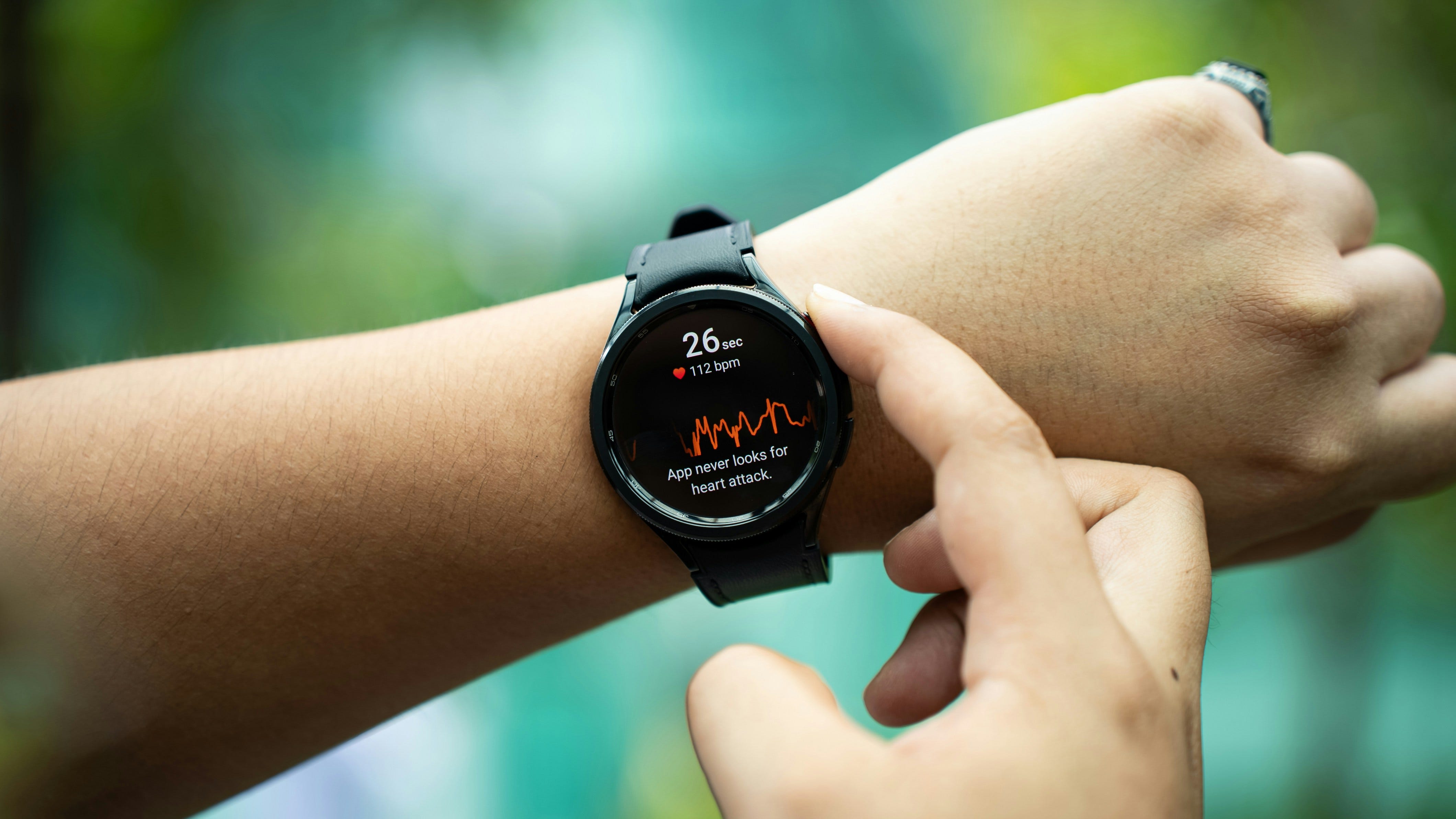
Consider the differences in these experiences and your behaviors.
You go for a run without a watch.
You go for a run with a simple watch that just has time.
You go for a run with HR monitor and GPS giving you pace.
You go for a run with a watch that uses all that data to tell you what to do, how to respond, when to push or call it a day.
How does your experience and agency shift through those four runs? Early on, it’s just you and the trails, listening to your body, figuring out how fast or slow to go based on your breathing and those internal signals. You get to decide and feel everything.
A simple watch has much of the same experience, except now you know how long you’ve been running. That plays into the decision making a bit, as now your training is more structured and you run around in circles in the parking lot to see those seconds tick over until it hits the 60-minute mark.
With the HR monitor, GPS, and the like, we know everything in real time. We’re constantly looking at the watch, missing the run, and outsourcing some of our decision making to the watch itself. Crept out of a “zone”? Slow down, even if you’re feeling great. We lose a bit of that connection to both the outside and inside world. But if we work hard, we can hold on to it and use the data.
The final frontier is one we’re just entering. What if your watch tells you what to do. It calculates when you’re going to hit the wall or run out of energy, so it actively tells you to speed up, slow down, or call it quits. There’s little decision making, and any that we might potentially do gets second guessed by the algorithm on our wrist.
At each different level, our experience changes. We shift from asking “What do I feel?” to “What does it say?” And at the last level, we stop asking at all. The first three levels give you information, and you still make the call. They keep agency and much of the connection between mind, body, and the world. The fourth takes it all away. It disconnects us from the inner and outer world, making us a kind of robot that follows instructions. We’ve gone from sensing, to measuring, to being told what to do.
Engineers outlined this process 50 years ago. In 1978, Sheridan and Verplank called it the levels of automation. They had 10 rungs, from level 1, “The computer offers no assistance, human must do it all,” through level 4, the computer “suggests one,” up to level 10, “The computer decides everything and acts autonomously, ignoring the human.”
This will be the problem of our time. One that you need to think deeply about, understanding the value and drawbacks of outsourcing. And what you want to protect along the way.
The Upside and Downside of Tracking
There are benefits to every level of automation. Take the running example.
It’s freeing to go on a run without a watch. But, a lot of that is because we get to choose when to do so. We can pick an easy run or long run and just enjoy it. But that’s also because for the workouts where pacing or timing matters, we can strap on the watch and lock-in. And we no longer have to do workouts where we need to know the pace on the track (or god forbid measure out the course with a wheel before).
Even the invention of readiness scores, which I love to hate on, provides some benefit. It gives the novice without an intuitive guide or a coach another voice that can sometimes prevent them from doing dumb things.
Go a step further, to a supercomputer on your wrist that reads heart rate, breathing, maybe someday lactate, and dials in your exact pacing. That will surely help a lot of people. We’ll have less blowing up in marathons, and perhaps even a reduction in injuries.
But we also lose something. The further along the path towards automation we go, we increasingly experience the thing itself in a mediated kind of way.
The run without a watch has a simple feedback loop. You decide how good or bad it was based on your internal reading of it. There’s no baggage. It’s you, alone, out there, with no judgment placed upon you. It’s why those runs are often the most freeing.
Add a watch and pace metric and now you’re stuck comparing. The worth of the run stops being about the experience itself and more about the metrics. Did you run faster, stay in the correct zone, and on and on. We start moving towards the watch being the judge, which then changes our actual experience of the run itself.
It’s exactly what psychologists found in a study called “The Hidden Cost of Personal Quantification.” In a series of experiments that covered walking, reading, and coloring, measuring the activity made people do more of it, but they enjoyed it less. After they took the tracker away, they did less of the thing than those who were never tracked at all. The authors summed it up nicely, “By drawing attention to output, measurement can make enjoyable activities feel more like work.”
While our enjoyment might take a hit, at least we still have a say. We use the measures as feedback, ultimately deciding if we listen to them. If we take it a step further and have our own personal dictator on our watch, we outsource that.
Now, we’ve taken our agency and decision making, and largely handed it to something else. Once again, it changes our relationship to the activity itself. We no longer have to listen to our body, to read those internal signals and decide what they mean in terms of fatigue and pushing onwards. Our interoceptive ability degrades. And even more so, we stop being the one making the call. We hand it over to the watch. This makes running more of an act of survival, of just dealing with the discomfort, instead of engaging with it.
The comparison I’d give is if you’ve run a VO2max test. That diabolical test where you go on a treadmill while they measure your breathing, and some evil person gradually increases the pace or speed until you are so exhausted that you either fly off the treadmill or cry uncle. The only decision you have is to stop.
When I ran this test in the traditional way or in a newer way where the athletes themselves were in charge of the speed and simply told figure out how to get yourself exhausted in about 10 minutes, the higher level athletes reached a higher VO2max when they were in control. For lower level athletes, it didn’t matter as much.
The point is, our sense of agency can impact our performance, and our experience of the thing itself.
An Era of Automation and Outsourcing
We’re all entering an era where we get to decide what level of automation we want for just about anything. Do we want the free flowing unmediated experience of just running and feeling it all. Do we want feedback, agency, or even at the extreme, the work done for us? It’s all possible now, unlike at any point in history.
Each level comes with tradeoffs. Understand them. And learn when to listen to the watch, and when to throw it away. That’s the lesson from those who have already been through this transition.
Flight instructor Warren "Van" VanderBurgh called them “children of the magenta.” As commercial pilots moved to more advanced autopilots, he noticed that there were pilots who had learned to follow the magenta line on their cockpit display which represented the planned route instead of flying the plane. He wasn’t anti-automation. He called it a selection problem. An automation-dependent pilot is one "who does not select the proper level of automation for the task and loses situational awareness which is frequently preceded by task saturation."
In a 2014 study, researchers varied the level of automation that a pilot was allowed to use in a flight simulator, from full autopilot to only hand flying. The pilots’ hands held up. Their instrument scanning and manual control were “mostly intact,” even when they rarely practiced. What slipped was the thinking. When the automation was taken away and pilots had to keep track of where they were without the map display, decide what came next, or notice that an instrument was failing, the researchers saw “more frequent and significant problems.”
And the pilots who struggled most were the ones whose minds had drifted while the automation was flying. As the researchers put it, “the retention of cognitive skills needed for manual flying may depend on the degree to which pilots remain actively engaged in supervising the automation." In other words, when we’re using auto-pilot, it allows our attention to go on auto-pilot as well. We’ve outsourced the doing, so our mind can drift instead of staying fully engaged.
As the lead researcher put it, we should be worried less “about things that pilots do 'by hand' in the cockpit and a bit more concerned about those things that they do 'by mind.’ ”
It’s for this reason that VanderBurgh had a rule, when things go wrong or get complicated, step down a level of automation. “If you find yourself asking ‘What’s it doing now?’ at a low altitude, disconnect the automation, and fly the airplane. Once the plane is stable, then go back to sorting out the screens.”
“What’s it doing now?” is the cockpit version of the question we started with. On the run without a watch, you ask, “What do I feel?” With the GPS, you ask, “What does it say?” And with the watch that tells you exactly what to do, you eventually stop asking any questions at all.
We’re entering a world where we can choose almost any level of automation. We can feel everything or nothing, make every call or hand them all away. So borrow from the pilots. Be intentional about what you outsource. And when things get hard, when the data and your body disagree, step down a level.
Go back to the first question.
What do I feel?
The best tools make you a better judge. The worst ones make you forget you were ever the judge.
Consider sharing this:
Quotes I’m Pondering:
“People need new tools to work with rather than tools that ‘work’ for them.”
— Ivan Illich, Tools for Conviviality (1973).
“Men have become the tools of their tools.”
— Henry David Thoreau.
Go Deeper. Research and Ideas to Explore More:
A new study takes on deskilling and AI offering a simple design principle to help out: “Human Goes First.” In a small study they found that keeping people involved in decisions preserves skill.
Is AI Making Us Stupid? New paper looks the impact of outsourcing our thinking and what we can do about it.
What happens to our sense of agency when most of our decisions arrive already made? A piece in The Atlantic on the ‘crisis of agency.’
Ben Meer’s new book How to Be Good at Life is well worth a read. It’s about how to create systems to make sure you can pursue the things you care about the most. Check it out.
If you want to keep the conversation going, I provide research and insights on the following platforms:
Instagram: Steve Magness
Substack: Steve Magness
Twitter/X: @Stevemagness
YouTube: Steve Magness
Facebook: Steve Magness