

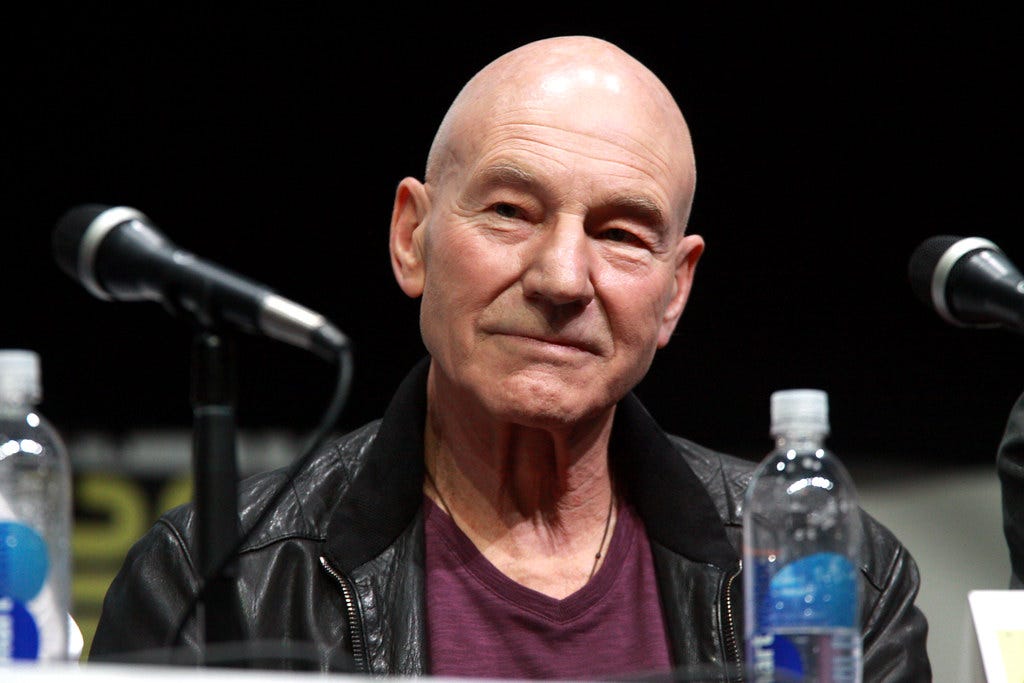
The legendary actor Patrick Stewart passed away this week. Whether it’s as Captain Jean Luc Picard, Professor X, or his numerous Shakespeare roles, his impact and acting prowess are beyond debate.
But behind the master craftsman was a man who was figuring it out. And in his wake, he left us with a masterclass on what it means to chase excellence and perform to our potential, regardless of your pursuit. Despite all of his success, he did what so many can’t: he showed us where he missed the boat. Where he had the wrong idea, one that may have served him initially, but ultimately held him back.
Because as Stewart came to realize, the greatest performers figures out how to shed the insecurities and baggage, to hold the contrasts like fun and discipline at once, and to both care and not care.
He was what I’ve called a both/and performer.
Wrestling with the Fear
Stewart grew up in a working class family with a father who came home from war with untreated “shellshock” and was violent to his mother. The stage became his safe place. For a few hours, he no longer had to carry the burden of the real world, or even be Patrick Stewart, as he told my good friend Rich Roll in a must listen podcast. He got to shed that identity and transform into someone else.
When he was 19, he was given a piece of acting advice from his teacher that stuck around: “You will never achieve success by insuring against failure.”
At first, he thought it simply meant take risks and be brave. But what he later realized, is that for years he was going against that very advice. He was hiding behind the wigs and characters he was portraying. He was constantly telling himself “that’s not good enough.” That might have seemed like it was pushing him at first, but what was really happening is he was holding back. He didn’t allow for the spontaneity, or his real feeling to shine through. The fear of being truly seen was holding him back.
He’d talk about having these walk off fantasy’s where mid stage performance, he’d just leave. Any runner will recognize this in the thought of ducking into a port-a-pot mid-marathon or “stepping in a hole” mid-race. Most of us have this devil on our shoulder trying to convince us to take the out.
It wasn’t until his late 30s, that Stewart realized the true point of the advice was to stop policing himself. To not let the fear of failure take over his performance. So he started to build tools that let him release the fear, or at least navigate it better.
Early in his career, an older actor had told him not to give a damn about how he was doing: just do it and let it come out. Decades later, before every entrance, Stewart would quietly say out loud “I don’t give a F***.” It was his way of taking away the “anxiety and stress and worry.”
You’ve got to care. It’s a rule of greatness in just about anything. Everyone from your little league coach to a legend in the field will tell you that. But, there’s a paradox in performance. For those chasing excellence, caring is often the thing that gets in our way. It’s what ultimately prevents us from reaching our potential.
Stewart didn’t actually not care. He was echoing what coaches like Nick Saban and Bill Walsh told their teams: let go of winning. They don't literally mean stop caring about the win. They understand that when pressure rises everything is pulling us towards the outcome. Our attention narrows too much, and we become blind to everything else. Our brain starts to treat it as do or die... and in turn we protect.
By declaring he didn’t care, he freed himself up just enough to be the best version of himself, instead of the one carrying the baggage.
Part of reaching your potential lies in giving yourself the permission to fail.
Seriousness can be a Mask
When he took on the role of Starfleet Captain, he brought his Shakespeare roots with him. He was serious, dedicated, and wanted to show deference to the craft of acting. Yet, the rest of his cast was goofing off. Stewart called a meeting, and lectured the cast on the seriousness of the endeavor, ending with him turning to castmate Denise Crosby and saying, “We are not here, Denise, to have fun.”
The rest of the cast laughed off his “pompous declaration.” And Stewart stormed off in anger. Yet, in time, he learned that they were right. That he had to put his ego aside, and to stop taking himself so seriously, while taking the work itself seriously.
It’s a subtle difference. But one he then tried to model by watching his co-star Jonathan Frakes relax on the set, but still be serious and dedicated to the craft itself. It took him most of season 1 to adapt, but in the end he realized that his need to be serious was insecurity rearing its head.
It was anxiety driving this need to have the appearance of this serious, dedicated Shakespeare actor. And it was getting in the way of not only him gelling with his cast, but in letting the real performance shine through. It was the old problem of wearing the wig or disguise, just in a different form.
Too often, we mistake being serious for being dedicated. They aren’t the same thing. You can be dedicated and goofing around until right before. In fact, it might just help you perform better. Some of my best races came when I was joking around with friends, before it came time to flip the switch.
And as a coach, I’ve witnessed so many performers think that as they reached the next level, whether that’s college or professional, that they need to be serious 24/7 now. But in acting the part, they lose the very fuel that drove much of their success.
We need both. Fun, joy, dedication. They aren’t contrasts, they are partners on the same path. The real secret to performance is what T.S. Eliot said long ago, “Teach us to care and not to care.”
Or as Stewart wrote, “Have fun. It is possible to do great work and have fun. I spent too many years being an uptight arsehole.”
Stepping Out of the Costume
“For a whole year, I played that guy, I lived that guy, and it became not good for me.” For an entire year, Stewart played Macbeth and the character was slowly taking over. He began drinking too much after the show, carrying the baggage of the character. As he told Rich Roll, he developed a shake out routine with his wife, “When I finished the day…I deliberately let it go…shake it out” He shakes his arms out, like a runner does to relax mid-race, “and now I can go home and have some supper and not be in absolute misery.”
Too often, we carry the baggage with us. Just ask any athlete who is still replaying the game or race while having dinner with their family, or resting their head on their pillow. It’s not just performers. We’ve increasingly gotten rid of the barriers that once forced us to transition. We take our work selves with us, the phone, laptop, and more. We even have gotten rid of the commute that provided a natural barrier.
Rugby great Jonny Wilkinson described the same trap: he never took the shirt off. The massive gain, he said, came from learning to. We’ve got to take the jersey off.
How?
Create a physical barrier. If you work from home, have a designated work space and transition to another room. Leave your phone or laptop in the work room. Or at least have a no go zone for where the work can travel with you. A doctor friend says he uses the garage door opening as his sign to leave it behind.
Develop your own signal. Your brain needs to know you are moving out of work or performing mode. It’s one reason why athletes cool down. But make it something more, like Stewart did. He shaked out his arms, told himself, and took a deep breath. He’s stacking the signals that say: let it go.
Take the literal jersey off. Change clothes. What you’re wearing sends a signal to your brain who you are supposed to be in this moment. Take the uniform off.
Set a time period. How long are you committed to the role or job? When’s your offseason? And on a shorter time period, when does the work day end?
Exploring the Unknown
On the screen, Stewart showed us all how to lead with both grit and grace, humility and confidence. Part of what made characters like Captain Picard brilliant was that they were human, wrestling with complex subjects. It’s only fitting that throughout his career, he kept the same openness.
Another person might have stubbornly stuck with what was bringing them early success. They would have given the speech on seriousness and dismissed any sense of fun. But Stewart showed us how to evolve. To let go of beliefs that worked for a while, but were no longer serving him.
That’s what great performers do. They are flexible and adaptable. Willing to wrestle with the messiness, to let go of the thing that made them good, because it’s the only way to find out how great they can be.
In the arena, actual performance is nuanced and complex. It’s not the trite advice you get online. It’s not the alpha slogans the bros tell you guarantee success and winning.
No, in the actual arena, it’s both/and. Everything helps. And doesn’t. It’s your job to go on the journey, just like Stewart, to continue to try things out, grow and evolve. So that you can show up as yourself, doing the thing you love to do. That’s a true performer.
The advice he got at 19 finally made sense: you can’t insure against failure. You walk into the unknown.
RIP Captain.
-Steve Magness
Quote I’m Pondering
“It is possible to commit no mistakes and still lose. That is not a weakness. That is life.”
-Captain Picard to Data
The Measure of a Man
One of Stewart’s best scenes, tackling a topic relevant for our time. Is the android Data human, conscious, or not? Stewart was at his best tackling philosophical problems. A brief clip, worth your time.
Thanks for reading. My goal is to make this the hub of performance.A place where we go deep on everything, from mental to physical, to help you strive for excellence. Consider sharing the work and subscribing.
-Steve
If you want to keep the conversation going, I provide research and insights on the following platforms:
Instagram: Steve Magness
Substack: Steve Magness
Twitter/X: @Stevemagness
YouTube: Steve Magness
Facebook: Steve Magness
Of course, the epitome of him not taking himself seriously was his appearance in Extras. Also, more recently, as the voice of the pig's head in Bait. Even more inspiring than his acting, was his support of domestic abuse charities. It shows you can be the top of your craft without being a tool.