

We just witnessed the best coaching job in history.
Indiana football has long been horrible. Regarded as the “losingest” team in major college football, they were a basketball program—a place where football dreams went to die. That is, until Curt Cignetti showed up and said, “I win. Google me.”
In an era of college football where the rich get richer, where 5-star players transfer for millions of dollars, and where Texas head coach Steve Sarkisian said just last year that we may not see an undefeated team for a long time because of those changes… how in the world did a team led by a 2-star quarterback, 0-star wide receivers and tight ends, and a bunch of 3-star recruits pull it off against talent juggernauts?
The 64-year-old Cignetti’s long and circuitous rise to the top has been well documented. But what stands out is a leader who is clear in both who he is and what kind of team he wants to build. At its heart, there’s a coaching philosophy built on the fundamentals, a loyalty to his staff, and a clear-eyed focus on helping kids get better.
In a world of performative nonsense—like dancing on TikTok to get a recruit or acting like you care about a kid only to look for their replacement in the transfer portal—Cignetti made genuine care and development his secret weapon.
Principle 1: Get the Right People
Cignetti’s journey included decades of being an assistant at numerous stops. When he finally got his shot to lead a program, it was at D2 Indiana University of Pennsylvania; he was nearly 50 years old and had limited money for much of his staff. His rise through the ranks was slow, moving to lower-level schools like Elon and James Madison before getting his “big shot” at Indiana.
As he rose, it would have been natural for him to look for bigger-name assistants. His salary pool increased from begging people to work for poverty wages to being able to pay hundreds of thousands. Yet, his assistants were the guys he brought along the way.
Offensive coordinator Mike Shanahan has been with him since 2016 at IUP. Defensive coordinator Bryant Haines has been with him since 2014. His special teams coordinator came with him from James Madison in 2019. He didn’t chase names when he hit the big time; he trusted his guys. He recognized that continuity was a superpower. “Everybody’s on the same page,” he relayed as the advantage. They’re committed to the program and the process. In an era of jumping around, Cignetti prioritized loyalty and rewarded his people for it.
That approach didn’t stop with his staff. His emphasis in recruiting wasn’t to play the game of “collecting stars.” “I am into production over potential… I’ve never really looked at stars, ever.” He focused on character guys who had a chip on their shoulder and who were obsessed with the game.
You can see it in their quarterback, Fernando Mendoza. Cignetti and offensive coordinator Mike Shanahan identified his “prep” and “obsession” as his elite traits.
It’s one of those easy-to-say, hard-to-do things. Everyone talks about character and desire, but it’s clear based on the IU roster that they knew what kind of players fit their program and focused on that. It’s a lesson legendary coach Leroy Burrell taught me during our run of NCAA success at Houston: “We’ve got to take the right chances on the right guys. We can’t just rely on the #1 recruit who’s perfect.”
So many other teams go for a collection of stars. Name programs can rely on collecting talent and hoping it works out for most of them. But as we so often see, that frequently backfires. One reason is that research shows an uncontrolled ego is a sync-killer. It prevents teams from gelling, both with one another and with the overall philosophy of the team. It’s clear watching Indiana that these guys were bought in with the same philosophy.
As Cignetti said, “We’re not going to recruit selfish guys, ‘I’ guys, or guys that don’t want to pay the price.” Again, it sounds cliché, but if you can actually live it and embody it, “we over me” wins. The problem is that most say it, but then in their day-to-day coaching, they give special treatment and exceptions to the stars. Their behavior reinforces “me,” so all the preaching gets ignored. And egos win.
Principle 2: Fundamentals over Fluff
“There’s no magic wand. It’s the fundamentals…”
“The best way is to… stack good days…”
“Control the controllables… be detailed in your preparation.”
“We’re process-driven: standards, expectations, accountability.”
In a time when hacks and shortcuts dominate the social media airwaves, it’s refreshing to see the basics winning in the actual arena. Why? The secret is the same thing that John L. Parker called “The Trials of Miles” for runners fifty years ago. It’s the same thing John Wooden expressed in basketball: accumulating solid, quality work over a long period of time.
Every coach under the sun preaches “process.” Coaching is a copycat business. But what Cignetti and other successful coaches do well is:
Clearly identify what the process actually entails.
Relentlessly come back to it. They don’t let wins or losses take them away from it.
Too often, coaches talk process, but their systems are haphazard and lack clear direction for what matters. Coaches preach process, but in the audience, players have no idea what that means. Cignetti is clear and repetitive:
“We talk about the same thing every single game – line of scrimmage, run the ball, stop the run… turnover ratio. We’re number one in the country… explosive plays… critical situations… Every game, same stuff.”
Process speaks the language of our brain: action. “Winning” doesn’t mean much to our brain, but being told we need to execute a specific style of play or focus on X, Y, and Z does.
The second part is what coach Tom House relayed to me when he was talking about the star athletes he’s worked with (Tom Brady, Nolan Ryan, Randy Johnson, etc.): “They only let winning take them out of the process for a moment.”
Principle 3: Even Keel
It’s the development of equanimity—a reminder that wins and losses, or good plays and bad, can pull you away from doing what matters. You mess up, and your brain lingers on the past. Or you get so caught up in success that you look past the play in front of you and start dreaming of the future.
These are the twin killers of success: lingering or apathy disguised as “future focus.” Kobe Bryant called it staying “dead center,” where he didn’t let his mind get too far into the past or future, or think too much about winning or losing. Cignetti preaches a similar philosophy of being “not affected by success, not affected by failure.”
By dampening the emotional sine wave of the season, Cignetti prevents the “emotional hangovers” that plague inconsistent teams. You can see it not only in what he says, but in how he acts on the sideline. He’s the definition of equanimity—the same whether it’s a miraculous play or a disastrous one.
I’m not against showing emotion; sometimes it can be the spark that lights a team. But we know that vibes are contagious. Research shows that if a coach is losing his or her mind on the sidelines, the players feel more stress. The coach is the thermostat, dictating the temperature. Cignetti uses his consistent stoicism to make sure that signal doesn’t go awry by transmitting nerves when players need to be calm, cool, and collected.
Principle 4: People Want to Be Coached
Cignetti is often described as “blunt-spoken” and “old-school.” He doesn’t engage in traditional coach-speak or show much emotional response on the sideline.
In our modern world, we often adopt one of two extremes. We think the younger generation needs excessive praise and constant validation partially to “re-recruit” them every season. Or, we put on the “grumpy old man” hat, complain about kids not being tough enough, and impersonate a “hard-ass.” Both miss the boat.
Cignetti coaches with authenticity. If a player performs poorly or messes up, they’re told about it and shown how to improve. If they perform well, they’re told “good job” and to do it again. Consistency matters. Players know where they stand and that their coach is going to help them get better.
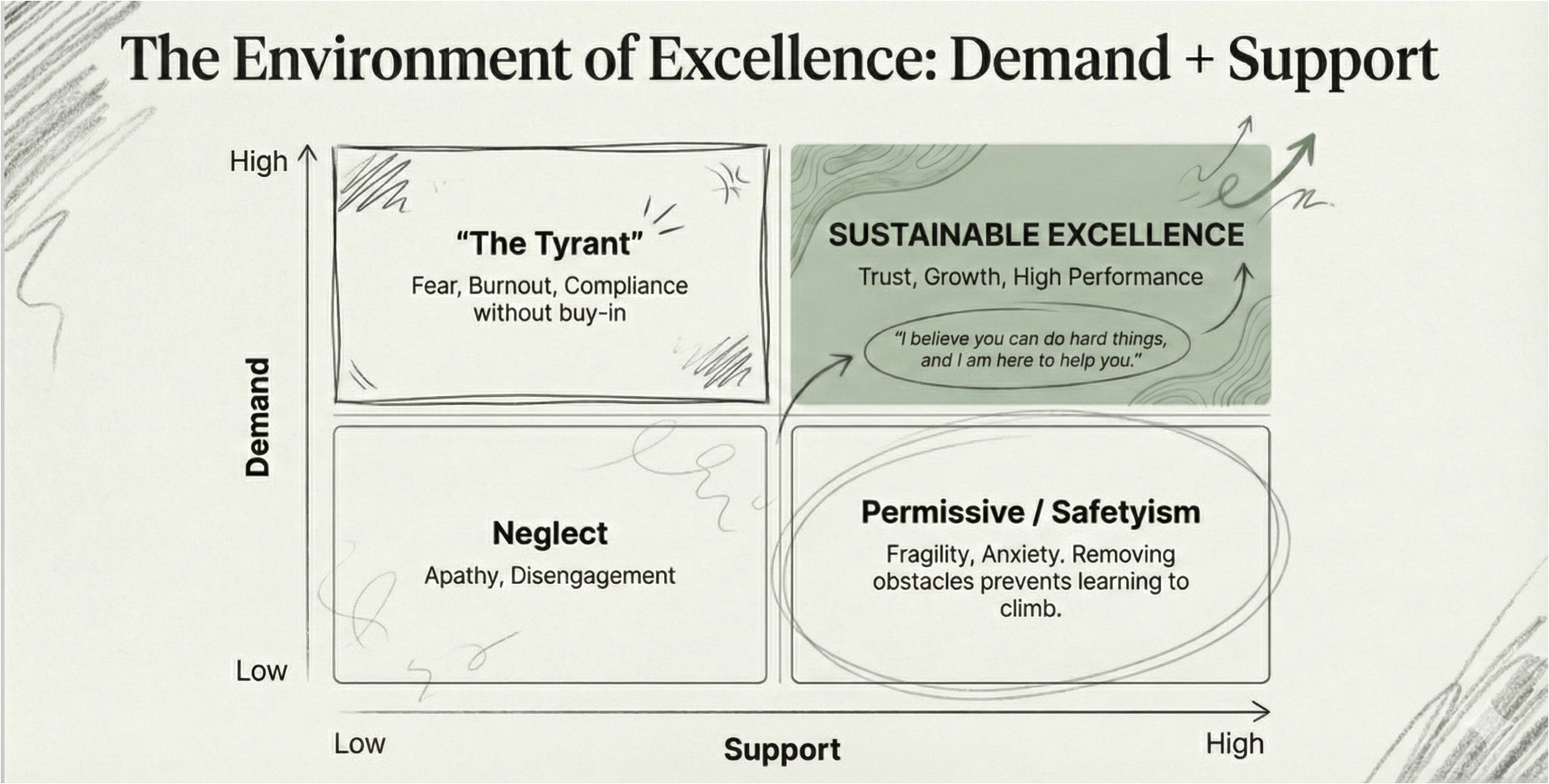
Cignetti’s approach reflects something I covered in Do Hard Things: coaching and parenting research tells us it’s not an “either/or”—it’s a both-and. The best methods marry high demand with high support. You have standards, but the kid knows you are there to help them. It reminds me of another Houston coach I witnessed firsthand, Kelvin Sampson. He talked about how kids wanted to be coached hard and held accountable, but to do that, they needed to know you cared and weren’t just using them.
Principle 5: Understand the Paradox of Intensity
There’s a paradox in football: aggression is encouraged, but too much of it causes a loss of control. You need intensity to be a lineman ready to bulldoze a 300-lb opponent, but too much leads to jumping offside or a roughing the passer penalty.
When aggression tips into rage, our goal-directed behavior shuts down. You can see this in road rage, where executive function is discarded. Cignetti demands that his teams be the least penalized and most turnover-averse. This paradox—playing with violent aggression while maintaining cognitive discipline—is the “special sauce.” It’s at the heart of the requirement to be “Smart, Disciplined, Poised.”
He’s not preaching calm as the absence of intensity; he’s teaching calm as the container that makes intensity usable. One undisciplined burst can negate ten dominant plays. In my work, I’ve come to think of this as controlled intensity: the ability to turn up force without turning off your brain.
The Vikings understood the same principle. They had berserkers, but their poetry also warned about the cost of mental fog in battle. The ideal wasn’t constant rage; it was ferocity paired with clarity. Pure fury looks powerful until it meets a disciplined opponent. Aggression is welcome, but it must be trained into a proactive force, not a reactive one.
I’m not on the inside; I don’t know Cignetti. The secret is almost assuredly that there is no secret.
Performance is complex. Too often we reduce it to slogans without realizing why those sayings became clichés in the first place. “Process over outcomes” was a way to recenter our focus away from the tendency to obsess over wins and instead focus on actions we can take.
Somewhere along the way, many forget the underlying purpose of those clichés. They are meant to balance out the messiness of performance and nudge us toward the items that matter. Most importantly, words must reflect actions. Cignetti seems to have figured that out. He knows who he is, he values his people, and he coaches by his principles every single day.
In a day and age when there’s so much superficial BS, where motives are unclear, relationships are transactional, and athletes often enter the arena wary of how much they are being used…clear expectations, honest feedback, and genuine care are superpowers.
Hats off to one of the most impressive coaching seasons I’ve ever seen.
I wish I could express properly what an inspiration you are to me. Your words resonate so strongly with my approach and outlook, that I take your insight and turn it toward my own goals. I keep seeing your posts, mostly on instagram and finding myself more and more drawn to a similar path. I want to help others find their inner voice and strength, by communicating clearly with actionable messaging and information. Nice job and thanks for sharing.
Coaches can make or break team. That goes for Gregg Popovich, that goes for Coach K, Steve Kerr, Tara VanDerveer, Dawn Staley, Kara Lawson, Geno Auriemma, Patrick Sang and other thousands of coaches in any walk of life.
Sticking to fundamentals, being authentic and flexible, putting in consistent work for years on end yields good results.