

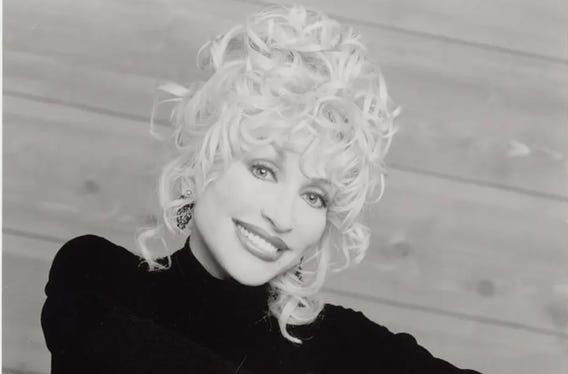
“Find out who you are and do it on purpose.”
I can’t stop thinking about this quote from Dolly Parton. It’s so simple, yet underneath it provides for a way of living life, which defined Dolly, and may be one of the reasons she was universally loved.
The quote contains two key ideas. We have to discover what matters to us. But discovery isn’t enough. We then have to enact it—deliberately and repeatedly—until our values become a way of living.
There’s not much more important from a psychological standpoint than your sense of self. Yet, too often, we think of our identity as something deep within us, that we introspect our way to. And sure, there’s some truth to that. But in doing so, we miss out on the other half of the equation, the one Parton so succinctly tells us about, “do it on purpose.”
We don’t merely discover the self, we act our way into it. We have to practice it, over and over again.
It’s in one of my favorite sayings I learned from podcaster Rich Roll “Mood Follows Action.” Or in other popular pithy sayings: confidence needs evidence, character follows repetition.
All of these get at the same phenomenon. They also have scientific validity, while tracing their roots much farther back than Dolly Parton.
The Power of Acting First
Behavioral activation is the essence of Roll’s “Mood follows action,” and it’s frequently utilized to treat depression. Instead of waiting to feel motivated to get going, you take a step forward, hoping to drag your motivation with you. In therapy, this often means scheduling small activities that align with your values. And it works well, one randomized trial for adults with major depression found that it performed comparably to medication.
The non-therapy version of this is the runner’s creed of “just get out the door.” Every runner knows the hardest step is often the first one. But once you get going, the momentum builds and you get the run in. So instead of trying to get motivated, you make it easier to take that first step.
But behavioral activation is on the small scale. What Parton was talking about was identity, a much bolder idea than simply changing how you feel. Aristotle gave us the theory long ago. In the Nicomachean Ethics, Aristotle argued that character is formulated through actions, “Men become builders by building and lyreplayers by playing the lyre; so too we become just by doing just acts.”
Modern research largely confirms his hypotheses. No, it’s not that introspection for clarity on who you are is useless. Our brain works in both directions. We are an actor, thinker, and observer. But too often, we try to think first, and discount acting.
On a larger scale, according to Daryl Bem’s self-perception theory, we infer who we are and what we believe by observing what we do. We take an action, we observe it, and what we see becomes evidence of who we are. Over time, we construct a story around whatever it is we’ve seen ourselves do.
“I’m kind…because I routinely go out of my way to help others…”
“I’m tough…because I’ve witnessed myself work through the pain cave…”
“I’m disciplined…because I sit down at my desk to write nearly every day…”
Psychologist Timothy Wilson has a slightly different name for the same phenomenon, “Do Good, Be Good.” When we volunteer at a soup kitchen, it changes our inner story. We start to see ourselves as an altruistic person. Classic studies on kids found that when they were encouraged to donate winnings from playing a game to charity, they ended up donating more money and sharing more with other kids. But crucially, this effect dissipated when they thought they were donating because it’s what an adult expected they should do.
In other words, it’s not just acting a certain way that does it. It’s the story we attach to it. I call this the youth sports phenomenon. Kids stop seeing themselves as baseball players, runners, or athletes because they come to realize that mom or dad are forcing them to do it. We see the same thing with activities like reading or volunteering. If you’re being forced, you ingrain “Dad made me do it,” not “I care about reading or helping others.”
Millennia ago, Aristotle issued a similar warning. “First he must act with knowledge; secondly he must deliberately choose the act, and choose it for its own sake….“
And once again, modern science backs him, largely showing that if we want behavior to shape our identity, we need:
The action is freely chosen.
There is no obvious external explanation, such as pressure or a large reward.
The person connects the behavior to something about themselves.
The behavior is repeated.
The identity is reinforced across more than one situation.
But can we really shift who we are?
The pushback on this is often, I get it on a small scale. But can it really make that big of a difference. A few recent studies put it to the test. In one 15-week study, participants identified personality traits that they wanted to develop and then were given some behavioral challenges that matched what someone high in that trait would do.
For example, if you wanted to be more extroverted, you’d be challenged to say hello to a random stranger at the coffee shop. Or if you wanted more conscientiousness, you’d be challenged to work for 30 minutes without looking at your phone. And over the course of the study, those who completed a large number of these challenges saw the greatest changes, particularly in extraversion, conscientiousness, and emotional stability.
The key part was actually doing the challenges. If you said you were going to try them, but didn’t follow through, no shift occurred. Or if you repeatedly tried the challenges and failed at them, you didn’t see a change. Those who figured out how to take small, trait-consistent actions reported changes in their personality.
Now, it’s important to note that it was a small shift in the levels of these traits. It wasn’t that someone deeply introverted suddenly became the life of the party. And a recent review had similar findings, small changes with interventions that focused on repeated behavior. But it helps back up Aristotle’s contention.
We become what we consistently do.
Dolly Being Dolly
The point of Parton’s wisdom isn’t to fake your way through life or to aim to transform yourself into someone new simply to fit in or benefit from it. She said, “Find out who you are and do it on purpose.”
It’s a dual-process. The acting is only part of the equation. It’s figuring out what matters to you, what values you hold, and then making sure your actions align with them…over and over and over.
She’s warning us about the pull of status and fame. That we imperceptibly shift away from what we once held dear, as we take actions that start revealing and prioritizing something else.
That consistency may help explain why in an age where tribalism reigns and division is the norm, Dolly Parton somehow transcended it all. Seriously, we have data on this. Four months ago, in a UMASS poll, she had a +65 net favorability rating. She was the only person tested whom majorities of Democrats, Republicans, and independents all viewed favorably.
She’d figured out how to have a clear, distinct public identity, but one where her values were remarkably stable. She didn’t ask people to believe a carefully constructed identity. Over decades, she supplied the evidence for.
Parton could have succumbed to the trappings of fame. She could have lost her roots. She could have stopped standing up and doing what she thought was right, especially when it potentially cost her sales and fans.
Yet, there she was throughout her life, sending books to millions of kids, funding vaccine research, paying families struck by disasters, helping increase graduation rates in her home county, supporting marriage equality, relishing her Appalachian roots, removing “Dixie” from an attraction, and writing songs about sexism, poverty, pregnancy, judgment, and working-class exploitation.
But Parton just kept acting in alignment with her values. She was the rare star who put doing above signalling. “It’s always nice to be recognized for what you do, although that’s not why you do it.” Instead of sending signals to a particular tribe, she led with human values. She told us as much, “I try to get into the human element of it.”
Dolly Parton might just be the perfect case study for Aristotle. And we can see it right there in her songs. In 2023, researchers analyzed 247 of her songs written between 1967 and 2020. They then compared them against every top-10 country and pop hit of the last fifty years.
Her lyrics scored highest in positive language. Maybe, not too much of a surprise there. But they also scored highest in negative language.
She tackled the hard stuff: poverty, heartbreak, betrayal, unplanned pregnancy, social injustice, suicide, and the death of a child. But she did so with just enough positivity to lift you up. Again, it’s in the data. Her songs used more language of “elevation” than either comparison group. Meaning, she had more lyrics that were about feeling moved, uplifted, or inspired by goodness.
And across her entire career, the positive tone never changed. The levels of awe, gratitude, elevation, and hope were stable for decades. Meanwhile over that same time frame both country and pop hits saw a decline in positivity.
She spent fifty years writing about poverty, heartbreak, and loss, and somehow left people feeling lifted by it. By looking straight at the thing and refusing to let it be the end of the story.
She found out who she was, and did it on purpose.
—Steve Magness
Thanks so much for reading my work. If you enjoyed it consider sharing it with others. The only way quality work spreads is if you help out.
Second, consider subscribing. You’ll get a free weekly newsletter on a topic about mental or physical performance and what genuine excellence is all about.
Applying this in Your Life
1. Identify what matters.
What are your values? Go through a values checklist and identify what resonates. Or think about someone in your life that you admire, what qualities do they have that you want to embody.
Write down a handful of values.
2. Turn the value into an action.
With your values, think of a small, deliberate action that someone with that value would do.
Instead of “Be social,” say “Every day on my commute home I’m going to call a friend I haven’t talked to in a while.”
3. Make the action small and freely chosen.
The key is to make it align and make it repeatable. It needs to be a challenge, but something that you can manage. And it’s got be something that you choose to do. You can’t outsource this.
4. Repeat
Make it like brushing your teeth or going for the run. It’s consistent nature that creates the transformation
5. Ingrain the Right Story
It’s not all action turns into story. Our interpretation and contextualization plays a role. We all know the person who suffers a loss or setback and it becomes an attack on their sense of self. And the person who fails, but somehow takes it as information instead of a verdict on who they are. Especially after setbacks, craft a good story. One that is authentic and true, but gives you somewhere to go in the future.
If you want to keep the conversation going, I’m active on the following social media platforms:
Instagram: Steve Magness
Twitter/X: @Stevemagness
YouTube: Steve Magness
Facebook: Steve Magness
My Books: Do Hard Things and Win the Inside Game
Gonna be rereading this one. :)
You are right about her being genuine. A sad thing lacking nowadays.
Also, she wrote two all-time classics in one day (Jolene, and I will always love you.' I mean, how mad is that?