

The NFL season starts off with one of the strangest natural experiments in performance we’ve seen. The Los Angeles Rams are playing the San Francisco 49ers in Australia. That means a 16 hour flight, landing in Melbourne which is in a time zone 17 hours ahead.
The 49ers arrived a week before the game taking the traditional acclimatization path. The Rams are planning to arrive just 24 hours before the game, staying on west coast time. We’ve got traditional approach versus a smash and grab that hasn’t really been done at this level with this long of a flight.
As an exercise physiologist who went deep on this years ago in deciding how to help prepare for athletes for far off Olympics and World Championships, let’s unpack the science and see who’s got it right.
The Science:
When it comes to travel, there’s a number of issues that can impact performance.
1. Time Change
The most obvious and studied one. We have a circadian rhythm that helps keep us awake when we’re supposed to be and fall asleep when we’re not. Hormones like cortisol and melatonin, along with our core body temperature all follow a natural rhythm. This rhythm is one reason why elite athletes tend to perform better in the afternoon or evening than first thing in the morning (though research shows you can adapt to it and perform just as well in the morning by training in the morning). Here’s a brief overview of that data:
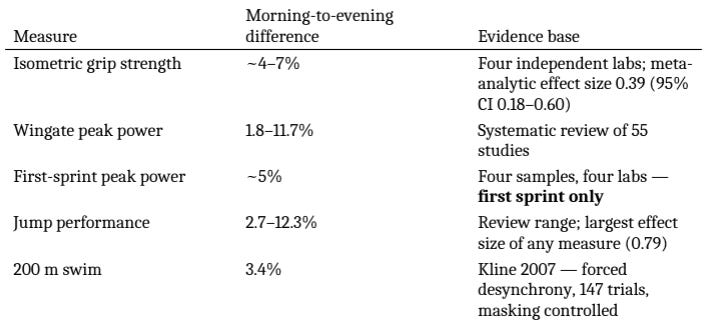
When it comes to impact of traveling, most of the research in American sports shows a very small shift when teams travel eastward. While some research from global sports, like tennis show impacts on sleep but no significant impact on performance.
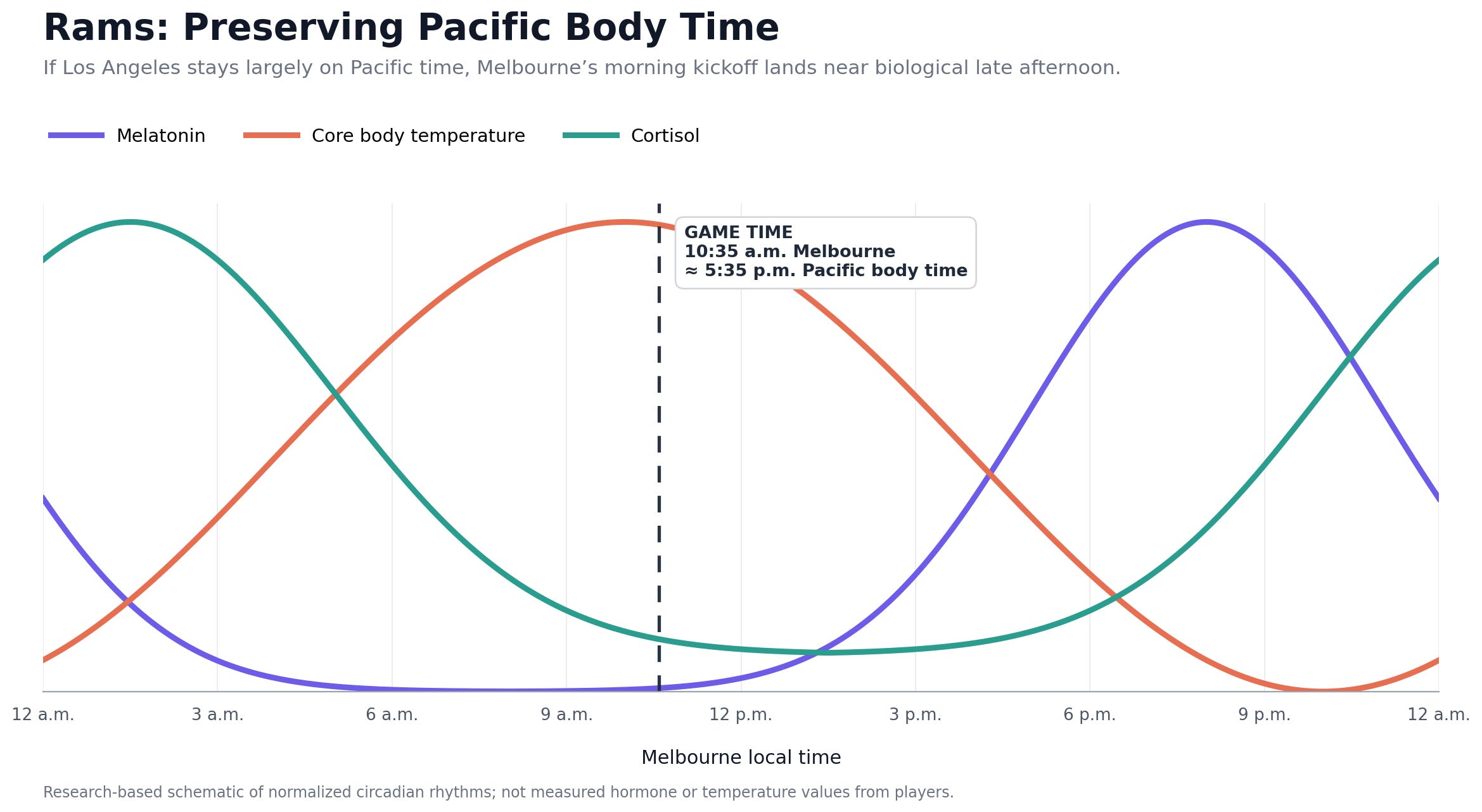
Here’s what the two strategies look like in terms of hormone release and body rhythm:
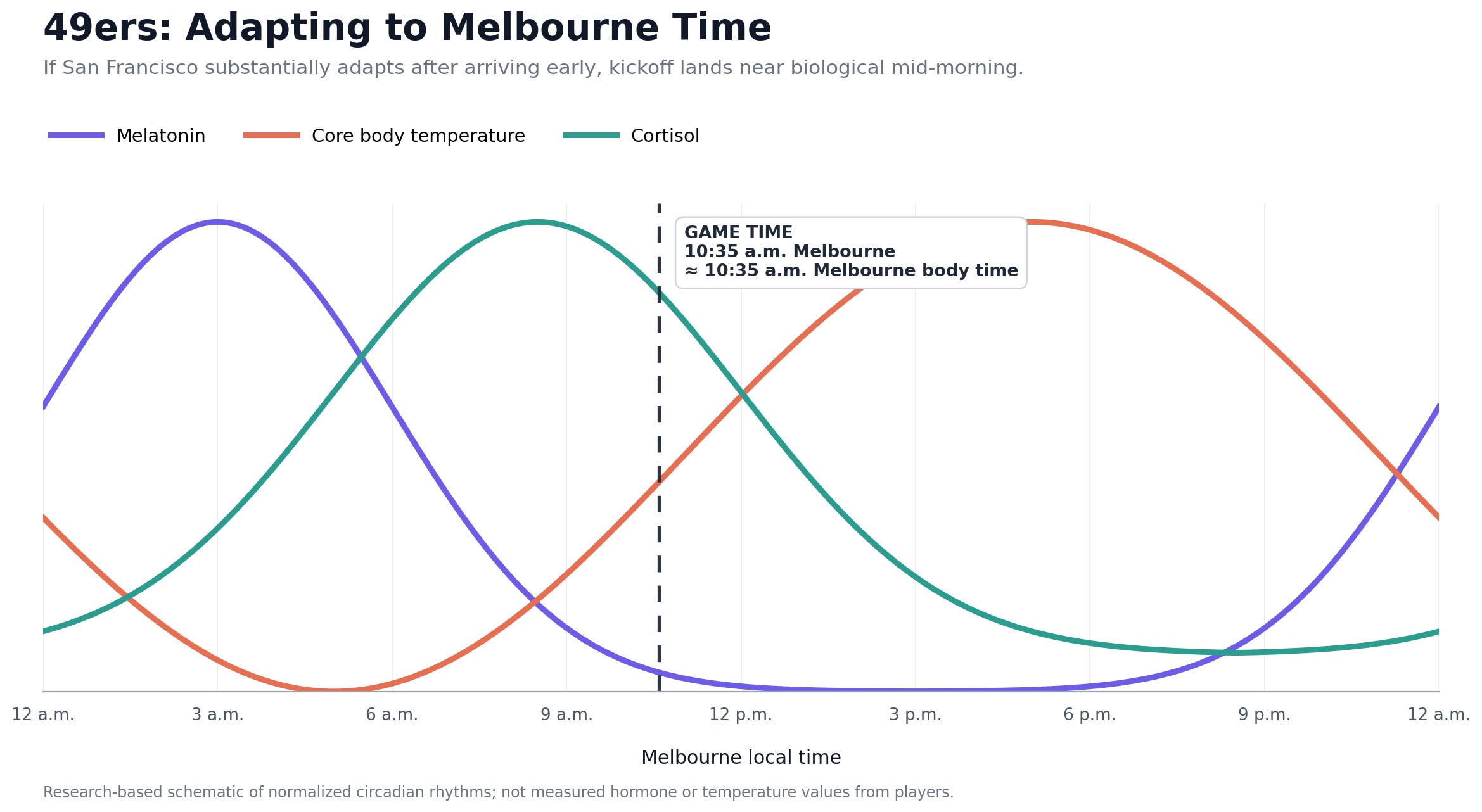
The 49ers get full adaptation. Their bodies will adjust. The rule of thumb is that you can adjust at roughly two hours/day traveling westward and one hour/day eastward. They’ll be going westward on the way there, trying to delay their clock 7 hours, which is in their favor. It’s much easier going west than east. It’s important to note this is a very rough rule of thumb and there is wide individual variability.
But it’s not all doom and gloom for the Rams. They are banking on the NFL’s scheduling to help them. The game is at 10:35am local time, which is 5:35pm west coast time. They’re betting that by staying on the same time zone, they’ll perform at their best.
It sounds crazy, but in track and field the 1996 Olympic champion in the 110m hurdles, Allen Johnson did this. When he went to Europe to compete, he stayed on US east coast time, routinely going to bed at 4am local time. It worked out okay for him I’d say…
The Rams essentially did that last year when they competed in Europe. But a 7 hour flight to Europe is a lot different than a 16 hour one to Australia. So while time zone shifts are normally what we worry about here, I don’t think it’ll be the main factor.
Advantage: Kind of a toss up, believe it or not. One is adapting. The other is still competing at a normal time for their body.
2. Sleep Disruption
Another piece connected to the time change is the disruption in sleep. Again, not rocket science, when we don’t sleep well, our performance and recovery can be impaired.
This doesn’t mean you’re doomed if you have a bad nights sleep, just ask all the runners with the pre-marathon jitters who can’t fall asleep and still perform well. One nights sleep is generally compensated for and not a huge deal. But it does mean the deck gets slightly stacked against you.
The 49ers minimize this. They’ll be well adjusted and sleeping well. The Rams are banking on being able to sleep on the plane. Now, I’m sure they have the state of the art plane beds, but still sleeping on a plane is not easy. It’s not as comfortable, you’re breathing in air that’s the equivalent of 6-7k feet altitude, you’re likely dehydrated, and the lighting/routine/etc. are all thrown off. Even in hotel rooms, we have the “first night effect” where we tend to get worse sleep in a new place because part of our brain is awake looking for danger. (It was to keep us safe on the savanna back in the day…). That’s compounded on the flight.
For instance, for soccer teams traveling from Australia to Brazil to play in the World Cup, their sleep on long flights was significantly less than they normally get (5.9 hours on average (4.8–7.0).
Advantage: 49ers by far. Sleeping on a plane is always going to be tougher.
3. Travel Fatigue:
What the Rams are fighting isn’t really circadian shifts, it’s the fatigue of travel.
It’s spending 16 hours breathing air that’s the equivalent of 6-7k feet altitude which will drop their blood oxygenation down from 98 to 91-94. While sleeping, it could drop even more. (And if we’re being honest, in heavy lineman who are going to be more likely to have even mild sleep apnea, this could be a bigger concern). In general, it’s a small, but significant effect that I’ve tested on myself and elite runners, and that we have data on. It’s having less than ideal sleep.
It’s the impact it has on hydration, and more importantly fluid loss. In the plane, humidity is typically very low, so we have more respiratory water loss. But it’s a minor amount in the grand scheme of things that can be compensated for. But more so, it’s that we have a fluid redistribution. Our plasma volume declines, some research showing by as much as 9% for a 10 hour flight. What does this mean? Think of plasma volume as helping your blood be more like water and less like sludge. The higher the plasma volume, the more quickly the ‘freeways’ move. Other research shows that we have increased edema in our legs, with one study on a simulated long haul flight showing the lower leg volume increasing by about 145ml.
It also shifts your resting muscle tension. In running, we refer to this as how much pop you have in your legs. When you’ve sat or even lied down on a plane for 16 hours, your legs get stiff. Their resting muscle tension has adapted, so that you’re no longer in a position to have that nice springy reactive stride. Anyone who has gone on even a 3-4 hour flight and then gone straight to the track or cross country course for a shakeout run knows this well. For explosive sports, it’s an even bigger deal.
If you look at the research, the first 24-48 hours is when most of the reported symptoms of travel fatigue are the worst. Most of the data shows that it causes acute shifts in anaerobic power, strength, and reaction time. We don’t have perfect data, as it’s hard to study. And it’s not like you have a universal decline in all athletic abilities. Some drop, others maintain, and still others you can compensate for with caffeine, adrenaline, etc. It’s why the research is messy, with some showing no decline in 30m sprint post travel to others showing a drop in power and explosiveness.
But as someone who’s traveled to Europe to compete, gone to New Zealand and ran the same day I got there, and spent a considerable amount of time talking to experts for how to compete at Olympic and World champs based on this stuff… it is not easy to get off the plane and compete.
Advantage: 49ers. This is the main issue the Rams face.
4. The Lasting Impact
While we’ve considered the impact on this current game, what about coming back home? The Rams and 49ers play another game 10-11 days later. This is where the Rams plan makes a lot of sense. They travel back after the game and don’t have to adjust their circadian rhythm again. Both teams will face a steep cost from travel fatigue, but the Rams don’t also have to adapt again. Now, there’s plenty of time before the next game to do so, so I don’t think lingering fatigue will be the issue. But the 49ers will lose more practice time under rested conditions on the back end.
Advantage: Rams
So what?
The 49ers took the safer and more traditional route. Get there in plenty of time, adapt, and give it your all. They are trading potential adjustment on the back end after the game. They also have the option of partial adaptation instead of full to smooth that out and even help performance. Think of it as: instead of adjusting so that you sleep from 11pm to 7am, you adjust to go to bed at 9pm and wake at 5am. You’ve adjusted 5 hours instead of 7, which puts the game at a normal NFL mid-day kickoff, and lessens the recovery on the back end.
The Rams took the riskier strategy, partially influenced by their success in doing something similar in London last year. But this isn’t London, and even then they had a 5 hour shift because they practiced on the east coast. Their real upside is not having to adjust their circadian rhythm twice within a week and a two week period.
The Rams want essentially no shift or adaptation. The worst place they can be is partially adapting, while carrying a sleep debt. So they need the blackout curtains, lights, and whatever else they need to keep on the same time zone.
It’s theoretically possible. And I have no doubt an NFL team will go all out to do so. But it’s a risky move. Hopefully, they talked to track star Allen Johnson.
-Steve Magness
P.S. I tried something new here. Article + Video breakdown. Did you like having both? Let me know.
Thanks so much for reading my work. If you enjoyed it consider sharing it with others. The only way quality work spreads is if you help out.
Second, consider subscribing. You’ll get a free weekly newsletter on a topic about mental or physical performance and what genuine excellence is all about.
If you want to keep the conversation going, I’m active on the following social media platforms:
Instagram: Steve Magness
Twitter/X: @Stevemagness
YouTube: Steve Magness
Facebook: Steve Magness
Great analysis. The Rams riskier strategy did not work out for them.
Here it is the Friday morning after, and you were spot on.