

Few topics elicit a visceral, defensive reaction quite like stating your views on parenting—especially those that apply to babies and adolescents. We hold our parenting beliefs like a moral sword ready for battle.
Use “cry it out” to sleep train? “You’re causing lifelong trauma!”
Breastfeeding for too long? “Attachment issues!”
Not breastfeeding long enough? “Your child’s immune system is doomed!”
And we haven’t even gotten to screen time, playing outside without supervision, daycare, discipline, or any number of other issues. Parenting advice might as well be politics or diet—realms where people hold their views so tightly that they can’t even imagine a different approach working.
We wanted to understand why this happens. And even more so, answer a pretty important question: Does it really matter? What moves the needle when it comes to outcomes?
Mommy Wars and Daddy Debates
Recently, a well-known psychologist, Scott Alexander, was roasted for writing about the chaos of raising twin 2-year-old boys. “You have no control… They’re walking all over you,” exclaimed the social media crowd. Similarly, there was a viral debate over whether sleep training was “the most insane thing to do to a child.”
I’m not here to debate the merits of individual suggestions. I’m a parent. I like to think we do a pretty good job, but being an ‘expert’ on parenting your own children does not make you an expert on parenting everyone’s children. But what I can so clearly see is that the intensity of the debate reaches a fervor that few others do. You can see it in the words “insane, trauma, damaging, abuse,” and so on. Why do we feel so strongly about whether someone else breastfeeds or bottle-feeds their baby?
It’s because it ties into our most precious possessions: our identity and morality. This strong reaction is a complex psychological defense mechanism. It’s not just that we’re defending a tactic or tool; it’s that we’re defending our sense of self. Our parenting isn’t just a part of who we are; it represents what we value, what we believe in, and our moral convictions. Increasingly, it also tells us what tribe we belong to. It’s this mixture of identity, morality, and tribalism that makes it particularly dangerous.
Moralizing Our Preference
Researchers Jean Dumas and Nissley-Tsiopinis found that when we moralize a behavior, it moves from the realm of personal preference to that of objective truth. We can’t imagine or accept any other alternative. We’ve made it “good versus evil.” When a parent believes that their method of discipline is not just effective but “right” in a transcendent sense, a challenge to that method is a challenge to their moral standing. This phenomenon creates a psychological environment where parents feel compelled to defend their choices as if defending a religious creed.
This can be “okay” for behaviors that are easy to categorize and fit precisely with our values (e.g., don’t kill someone). But when we sanctify something much more ambiguous (like how we should discipline our children), it locks us into a rigidity that not only prevents us from considering alternative viewpoints but also condemns those who do the opposite as “bad.” It’s a double whammy of locking ourselves into one style and defending it until death.
A group of Finnish researchers found something similar when studying 162 parents. Identity foreclosure—where we narrow our view of ourselves and how we parent—predicted rigidity and a “denial of information” for any data that contradicted their viewpoints. Meaning, once your sense of self is wrapped around a style of parenting, you are trapped in a never-ending hell of cognitive dissonance. Any research, examples, or real-life experiences that counter that foreclosed identity are pushed away. As one group of researchers put it, you become “comparatively immune to authority or peer influence.” On the other hand, those who maintained more exploration viewed differing opinions “non-defensively and reflectively.”
Performing for the Tribe
One of the reasons we moralize parenting at a higher rate is the signal it sends to others. We’ve increasingly made parenting performative. It’s not only about raising good children; it’s a reflection of who you are. Any parent can tell you about the judgment they face. Use plastic bottles or toys, and in certain groups, you get the message: You don’t care about your child. The influencer phenomenon has taken off to such a degree that if you don’t follow the implicit rules online, you’re looked down upon or even ostracized. Depending on which corner of the influencer world you sit in, each has some form of strict “good” and “bad” behavior.
The rise of social media has accentuated this signaling because these tribes have become clearer and easier to join. Thirty years ago, besides a few bestselling books, it was hard to find outlier niches. They still occurred, but it was much harder to get your entire Gymboree parenting clique on the same page. Now, you can find a tribe that believes just about anything and get constant reinforcement through videos, messages, follows, and likes.
We’re naturally tribalistic creatures. Social Identity Theory tells us that we derive a significant portion of our self-concept from group memberships. It’s just that those groups used to be in real life with people you knew at a deeper level. Now, they are often with random strangers, where the only thing holding the group together is an ideology. We see them on all sides: free-range parents, gentle parents, tiger parents, and so on. Once we categorize ourselves into one of these tribes, it activates our deeply ingrained “us vs. them” mentality.
Parenting Takes Work
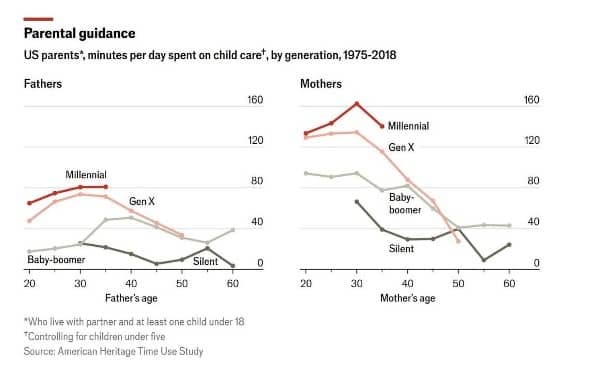
Parents are more involved than ever. Recent data shows that the time dads spend with their children has increased dramatically. But interestingly, the time moms spend with kids has gone up, too! It’s not that dad is relieving mom; it’s that everyone is spending more time parenting.
One impact of this extra investment is that it primes us for the sunk cost fallacy. The harder we work at something, the more we have to justify that investment. We want our hard work to pay off. When a stay-at-home parent sacrifices opportunities in the workplace, they may double down on the importance of that choice and the style of parenting that comes with their tribe. Conversely, a parent who works long hours may believe that independence and socialization are superior to constant presence. To believe otherwise would be to live with the crushing guilt of “abandoning” their child.
Does it Matter?
Research consistently shows that within the “normal range,” variations in parenting style matter far less for child outcomes than most parents believe. Kids aren’t blank slates or a piece of clay to mold to our will; genetics play a massive role.
Research tends to show a strong threshold effect. Bad parenting (neglect or abuse) impacts children significantly—this is why studies on the classic Romanian orphanages show such large effects. But once you reach the “good enough” or solid parenting threshold, the impact of specific “styles” gets much smaller.
In the 1980s, Sandra Scarr and Kathleen McCartney put forth a model suggesting that the parenting environment simply needs to be “good enough” to support a child’s genetic potential. Once a threshold of basic safety, nutrition, love, and stimulation is met, the particular details of the style have a very small effect on a child’s personality or intelligence.
More recent work suggests that parenting influences the path you take, even if it doesn’t change your fundamental self. If you value education, there’s a higher likelihood of the child going to college. Our expectations shape the paths available to our kids.
We like to think of it in coaching terms. There’s a big leap in performance when you move from a poor coach who gives you intense intervals six days a week to a solid coach who follows a traditional training program. But once you get a coach who nails the fundamentals, the difference between “good” and “great” is small. Most of the gains are found in the fundamentals.
In parenting, those final details matter to you, and you get to decide how to handle them. But let’s not treat the choice between six 400m repeats or eight as a life-or-death existential crisis. Too often, we make that argument in parenting.
So what?
I’m not here to discount your decisions. You know your child best—and that’s the point. In a world where comparison is rampant and tribalism is high, let’s take a step back. Showing up as a neurotic, tribal person is not good for you or your child. Showing up with empathy, care, and understanding is. In the long run, the specific ‘style’ you choose matters far less than the environment of care you create while doing it.
Put down the moral sword and pick up your child; they don’t need a perfect coach, they just need you.
– Steve
As an aging boomer with adult children, I've reflected on this a lot and had discussions with both of my girls about their perspectives. So much of this is our "optimization" culture. I think that you kind of nailed it in "Do Hard Things." Parenting does require the kind of "toughness" that you describe. Adaptation, flexibility, patience, and positive self-talk in the face of a lot of doubt. My wife and I were thrown a lot of unexpected curveballs as our two girls grew up. We made a lot of mistakes (something that they are fond of reminding us of - lol!). The key thing was that each of them was an individual who had their own skill set, areas of need, and response to the stress of life. We as parents had to adapt on the fly and make our decisions based on that. At times, it certainly seemed unfair to one or the other of them. However, when you are in the moment, just like in a marathon, you have to make certain adaptations based on the situation you have at the time. Parents just won't know if they made the right decision until they get where I am now. Maybe a little humility would be helpful.
Good column. Parenting is the most important thing any of us will do. There are certainly different ways to do it. I'm curious about that stat that says dads and moms are spending more time with kids. I'm a bit skeptical of that stat, but would be happy to be wrong. First thing that popped in my mind is there are more single moms than ever, which right away should be detrimental to those stats. Moreover, how many couples stay together? The breakdown of the traditional family is a critical problem in modern America. Improve it and every other issue will get better too.
Having raised our own two boys, parenting is the greatest education and period of growth any of us will experience. I can also say, telling other people how to parent is flirting with a volatile, explosive substance.